目录
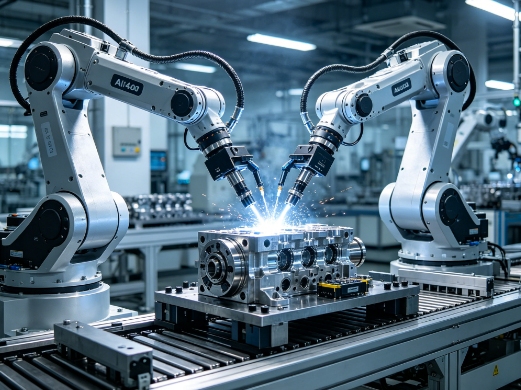
In recent years, smart manufacturing has become a major trend across global industries as companies shift toward automation, digitalization, and intelligent production systems. In this transformation, the 5 axis robot arm has gained significant attention due to its flexibility, precision, and ability to handle complex manufacturing tasks. Unlike traditional robotic systems with limited movement, it provides multi-directional control that fits perfectly into modern smart factories. As manufacturers aim to improve efficiency, reduce costs, and enhance product quality, the 5 axis robot arm is increasingly seen as a key technology driving the next generation of industrial automation.
Advanced Flexibility for Complex Manufacturing Needs
One of the main reasons the 5 axis robot arm is becoming popular in smart manufacturing is its exceptional flexibility in handling complex production requirements.
- It can move across multiple axes simultaneously, allowing it to perform operations from virtually any angle without repositioning the workpiece.
- This flexibility makes it suitable for irregular shapes, curved surfaces, and multi-layer structures commonly found in advanced industrial products.
- In smart factories, where production lines are frequently reconfigured, its adaptable movement helps maintain efficiency without major hardware changes.
- It can seamlessly switch between different tasks such as assembly, cutting, and surface processing within the same production environment.
This level of flexibility aligns perfectly with the dynamic and customizable nature of modern smart manufacturing systems.
Integration with Intelligent Automation Systems
Smart manufacturing is not merely about mechanical automation, but rather about data-driven and interconnected production systems. The 5 axis robot arm fits naturally into this ecosystem due to its compatibility with intelligent technologies.
- It can be integrated with AI-driven control systems that optimize movement paths and improve operational efficiency.
- Machine vision systems allow the robot to identify objects, adjust positioning, and correct errors in real time.
- IoT connectivity enables continuous data exchange between machines, improving coordination across the entire production line.
- Predictive algorithms help reduce downtime by identifying maintenance needs before failures occur.
These intelligent capabilities allow manufacturers to build highly automated and responsive production environments.
High Precision and Consistent Quality Output
Another important reason for its rising popularity is the consistent precision it offers in manufacturing processes.
- The robot maintains stable accuracy across long production cycles, ensuring uniform product quality.
- It reduces human-related variability, which is especially important in high-precision industries such as electronics and aerospace.
- Multi-axis control allows fine adjustments in positioning, improving machining and assembly accuracy.
- Built-in feedback systems help correct deviations instantly, ensuring that every output meets strict quality standards.
In smart manufacturing, where consistency and reliability are essential, this level of precision is highly valuable.
Increased Efficiency and Reduced Operational Costs
The 5 axis robot arm also contributes significantly to improving production efficiency while lowering operational costs, making it highly attractive for modern factories.
- It can operate continuously without fatigue, increasing overall production output.
- Automation reduces the demand for human labor in repetitive or physically intensive tasks.
- Efficient motion planning minimizes wasted movement and shortens production cycles.
- Lower defect rates help reduce material waste and rework costs over time.
These advantages make it an economically efficient solution for large-scale and high-volume manufacturing environments.
Support for Smart Factory Transformation
As industries move toward fully digital and intelligent factories, the 5 axis robot arm plays an important role in enabling this transformation.
- It supports flexible manufacturing systems that can quickly adapt to new product designs.
- Data collected from robotic operations can be analyzed to improve production planning and optimization.
- Its compatibility with automated production lines helps create fully integrated smart factory ecosystems.
- It allows manufacturers to shift from traditional fixed production models to agile, demand-driven manufacturing.
This adaptability makes it a core component of Industry 4.0 development.
Conclusion
The 5 axis robot arm is becoming increasingly popular in smart manufacturing due to its flexibility, intelligent integration, high precision, efficiency improvements, and strong compatibility with modern smart factory systems. As industries continue to evolve toward automation and digital transformation, this advanced robotic technology is playing a crucial role in reshaping production methods. Its ability to combine mechanical precision with intelligent control makes it a key driver of future industrial innovation and a foundational element of smart manufacturing development.
0