目录
Compared with other cable types, it offers improved structural strength, flexibility, and environmental adaptability. As FTTH deployment continues to expand in residential, commercial, and industrial areas, understanding the advantages of using a round drop cable in FTTH installations is essential for network planners, installers, and telecom engineers aiming to achieve stable and efficient connectivity.
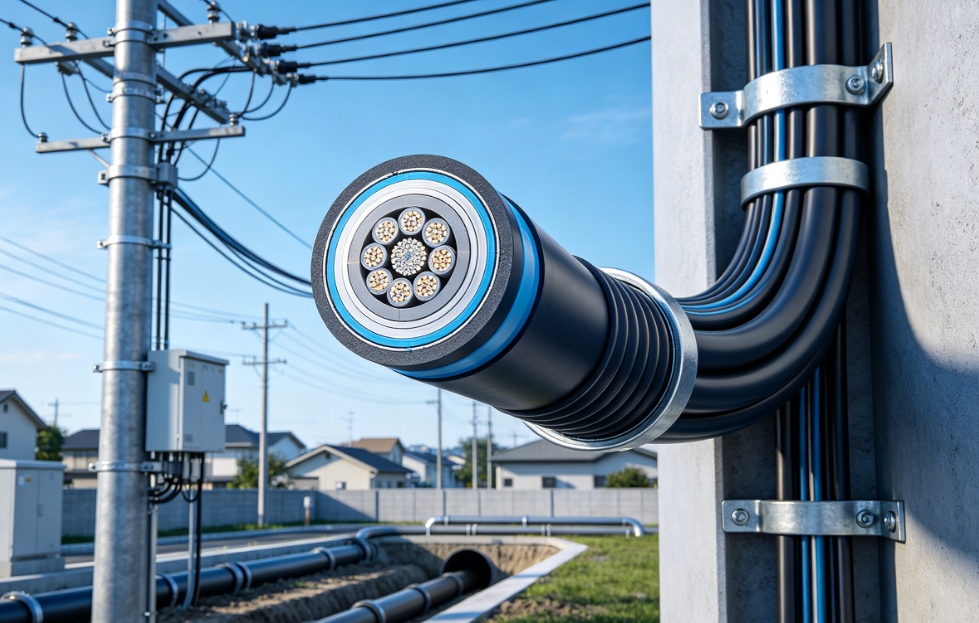
Enhanced Mechanical Strength and Structural Stability
One of the most important advantages of a round drop cable is its superior mechanical performance compared to flat cable designs.
- Multi-layer circular structure design
The round shape allows multiple protective layers, including the fiber core, strength member, and outer sheath, to be evenly distributed. This improves overall structural balance and reduces internal stress during installation. - Improved resistance to pulling and bending forces
Unlike flat cables, the circular design distributes tension more evenly, making the round drop cableless likely to deform or break under mechanical stress. - Better protection for internal fiber units
The enclosed structure minimizes the risk of fiber micro-bending or cracking, ensuring stable signal transmission even under physical pressure. - Suitable for long-distance deployment scenarios
Due to its strength, it is commonly used in FTTH projects where cables must span long distances between poles or buildings.
Strong Environmental Adaptability for FTTH Networks
Another major benefit of using a round drop cable is its ability to perform reliably in different environmental conditions.
- Resistance to temperature fluctuations
The materials used in round cable jackets are designed to withstand both high and low temperatures, ensuring stable operation in diverse climates. - Protection against moisture and UV exposure
High-quality outer sheaths prevent water penetration and UV damage, which is essential for outdoor FTTH installations exposed to sunlight and rain. - Wind and weather durability
The round structure reduces wind resistance compared to flat cables, making it more stable in aerial deployments during strong wind conditions. - Reduced risk in harsh environments
In rural or coastal FTTH deployments, the cable performs reliably even under salt, dust, or high humidity conditions.
Improved Signal Transmission Stability
Stable data transmission is critical in FTTH networks, and round cable design contributes significantly to maintaining signal quality.
- Reduced signal loss due to bending protection
The internal structure of the round drop cable helps maintain proper fiber alignment, minimizing attenuation caused by sharp bends. - Consistent optical performance over distance
The uniform protection ensures that light signals travel smoothly through the fiber core without distortion or interruption. - Lower risk of micro-cracks in the fiber core
Mechanical stress is better distributed, reducing the chance of internal damage that could affect transmission quality. - Stable performance in high-bandwidth applications
Suitable for modern internet services such as 4K streaming, cloud computing, and smart home systems requiring consistent speed.
Flexible Installation and Wide Application Scenarios
The round drop cable is also widely preferred due to its installation flexibility in different FTTH environments.
- Adaptability for aerial and indoor installations
It can be used both in overhead pole systems and indoor routing, making it suitable for mixed deployment projects. - Easier handling during the installation process
The circular shape allows smoother pulling and routing through conduits or support structures. - Compatibility with various FTTH architectures
Works well in point-to-point, point-to-multipoint, and hybrid network designs. - Reduced installation errors and maintenance needs
Its durability and flexibility reduce the likelihood of installation damage, lowering long-term maintenance costs.
Cost Efficiency and Long-Term Network Value
Although a round cable may have a slightly higher initial cost than simpler designs, it provides better long-term value.
- Lower maintenance and replacement frequency
Due to its durability, network operators spend less on repairs and replacements over time. - Reduced downtime in FTTH systems
Strong protection minimizes the risk of unexpected failures, ensuring consistent service delivery. - Efficient large-scale deployment advantages
In mass FTTH rollouts, using round drop cable reduces long-term operational costs despite higher upfront investment. - Better return on infrastructure investment
Longer service life and stable performance increase overall network ROI for telecom providers.
Conclusion
The use of a round drop cable in FTTH installations offers multiple advantages, including superior mechanical strength, strong environmental adaptability, stable signal transmission, and flexible installation options. While it may require a slightly higher initial investment, its durability and long-term performance make it a cost-effective choice for modern fiber optic networks. As FTTH infrastructure continues to expand globally, selecting the right cable type plays a crucial role in ensuring reliable connectivity and efficient network operation.
0