目录
In the ongoing evolution of urban infrastructure, municipal authorities worldwide are systematically replacing legacy signaling systems with advanced LED traffic signal lights. Traditional incandescent and halogen traffic signaling systems have been a headache for municipal maintenance crews for many years because of their inefficiency in terms of power usage, burnouts, and overhead costs associated with their operation. In light of higher traffic levels and stricter carbon emission requirements, switching to efficient LED traffic signals has become not only desirable but a municipal necessity. Sinowatcher is one of the companies that play a key role in making such a shift happen by designing highly visible optical systems.
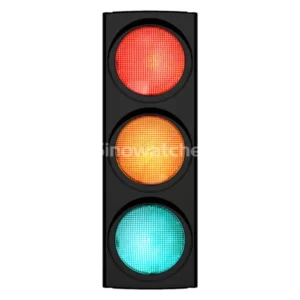
Energy Efficiency and Power Savings of LED Traffic Signal Lights
The energy efficiency factor is the main driver that prompts local municipal decision-makers to replace old lighting technology with LED traffic signal lights. Old incandescent lamps have low luminous efficacy, in which most of the electrical power is wasted in the form of thermal energy without producing much light energy.
High Luminous Efficacy Factor
New LED traffic signal lights directly convert the electrical energy into monochromatic light with high luminous power efficiency and draw less current.
Significant Decrease in Wattage Requirement
While an ordinary incandescent signal head uses 60 to 150 watts of electricity, an equivalent LED traffic signal light uses only 10 to 20 watts of electricity.
Large Energy Savings for the Municipality
Changing all the signals of a large urban grid consisting of thousands of intersections to LED traffic signal lights reduces the total electricity requirement by 80% to 90% of the old level. This leads to substantial utility savings in municipalities, which can be used for other development work.
Moreover, this large reduction in power consumption makes it easier to manage municipal power grids, especially in the summer season when load increases due to both air conditioning and traffic signals. By lowering thermal output inside the signal housing, LED technology also minimizes heat-induced warping of external plastic visors and housings, prolonging the physical integrity of the entire assembly across diverse geographical climates.
Enhanced Visibility and Safety Offered by LED Traffic Signal Lights
Intersection safety depends entirely on instant, unambiguous visual communication for motorists, cyclists, and pedestrians alike. Incandescent bulbs are notoriously vulnerable to the “phantom effect,” a hazardous optical illusion where external sunlight penetrates the outer lens and reflects off internal mirrors, tricking drivers into thinking a lamp is illuminated when it is actually unpowered.
| Performance Metric | Traditional Incandescent Signals | Sinowatcher LED Traffic Signal Lights |
| Light Emission | Broad-spectrum light filtered through colored lenses | Pure monochromatic direct-emission diodes |
| Phantom Effect Risk | High susceptibility to sun phantom glare | Eliminated via advanced optical design |
| Beam Directionality | Omnidirectional, requiring external reflectors | Precise directional beam angles for targeted visibility |
Eliminating the Phantom Effect
Because LED traffic signal lights emit pure, unadulterated monochromatic hues directly from the source without relying on fading colored filters, they eradicate sun glare confusion completely.
Weather Penetration
Whether cutting through torrential downpours, heavy fog, or glaring midday summer sun, LED traffic signal lights project sharp, brilliant signal boundaries that drastically curb intersection collision rates.
Additionally, the instantaneous switching time of diodes—turning on and off in nanoseconds compared to the thermal lag of incandescent filaments—ensures that split-second amber and red phase changes are communicated instantly, giving drivers crucial extra feet of reaction time at high speeds.

Long Lifespan and Reduced Maintenance Costs of LED Traffic Signal Lights
In fact, the cost of municipal lighting goes beyond purchasing expenses – further upkeep, bucket truck involvement, and manpower become the key components of long-term economy.
Long Service Life: Incandescent lamps have extremely limited service life, often failing to work for up to 1,000-2,000 hours. In comparison, high-quality LED traffic signal lights feature an average service life of 50,000-100,000 operating hours, which equals at least 5-10 years of continuous hassle-free service.
Reliability
Constructed based on solid-state semiconductor technology rather than fragile tungsten filaments, LED traffic signal lights easily resist constant vibrations caused by the passage of heavy semi-trucks over road sensors.
Effective Maintenance Regimes
Sinowatcher develops modular LED traffic signal lights, thus reducing installation and replacement processes and, as a result, protecting maintenance personnel from the dangerous conditions at the roadside and minimizing labor expenses for the municipality.
Less burnt out lights equal fewer citizen complaints, down time of traffic signals and liability problems caused by malfunctions of street intersections. Municipalities can redeploy specialized electricians for other more complicated projects.
Eco-Friendly and Sustainable Advantages of LED Traffic Signal Lights
Increasingly, sustainability policies for the global community require stringent adherence to environmental protection standards in public works projects.
Hazard-Free Composition: Legacy specialty lamps and fluorescents are made from hazardous substances such as heavy metals, including mercury, and present difficult waste-disposal situations when expired. LED traffic signal lights are produced entirely free of any hazardous chemicals and can be safely recycled at end of life.
Reduced Carbon Emissions
With the reduced power usage of up to 90%, municipalities reduce the fossil fuel emissions of regional electricity grids. The implementation of LED traffic signals is a practical method of reaching net zero emissions goals within a municipality and improving ecological balance in the process.
Conclusion
Upgrading the urban road system requires a dependable and affordable system of lighting. In terms of energy savings and daytime visibility, durability, and reduced maintenance costs, LED traffic signal lights are a critical component of any progressive city. Through the application of efficient products from reputable companies such as Sinowatcher, city planners can ensure improved safety and sustainability of the future environment.
0