目录
Traffic lights are a crucial element that controls the movement of vehicles and pedestrians and minimizes conflicts within road intersections. There is always a system of mechanical and electronic devices behind these red, yellow, and green lights. Each device serves a definite purpose ranging from detecting any moving object towards the light to collecting traffic data and controlling the traffic lights’ operation. Learning about the key elements of a Traffic Light Control System will help to assess its performance and requirements.
1. What Is a Traffic Light Control System?
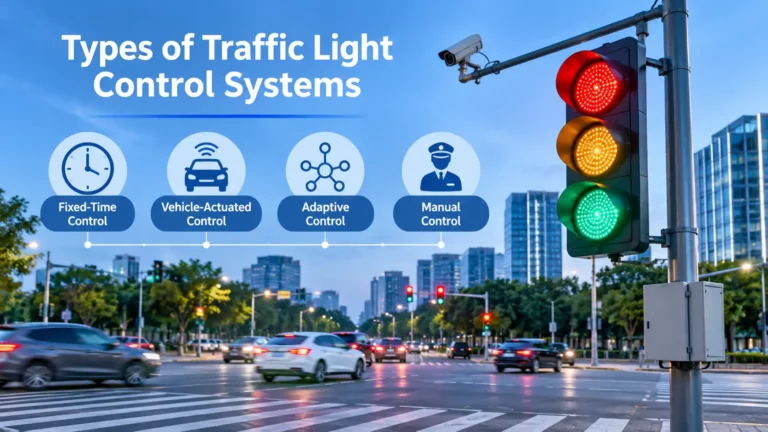
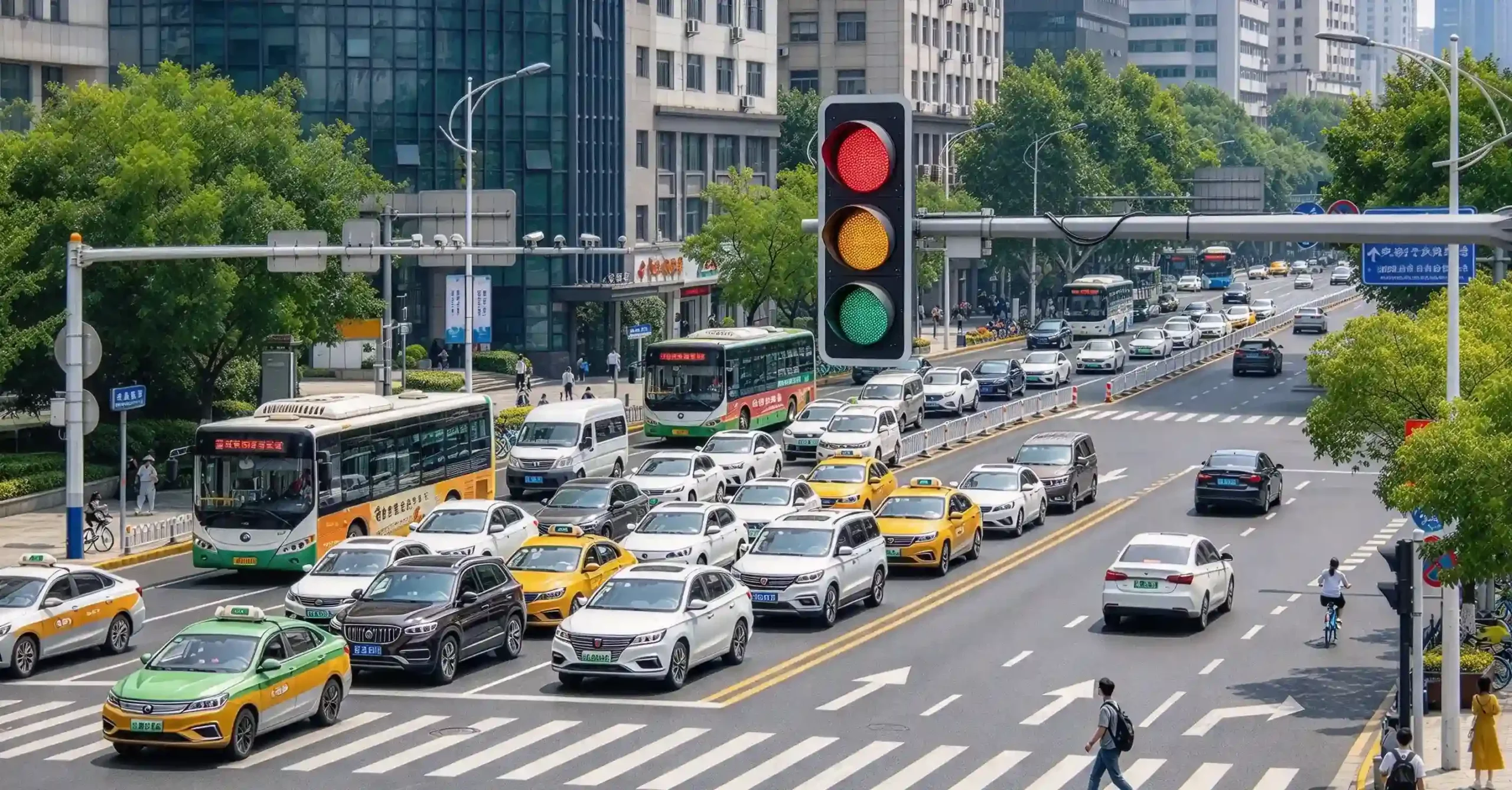
Traffic Light Control System is a system that consists of various controllers, signal heads, detectors, communication facilities, and power devices that control traffic movements at the intersection. It works based on a fixed timing scheme or traffic conditions, depending on the type of control employed. The system controls various traffic movements such as:
- Through traffic traveling straight across an intersection.
- Turning vehicles entering or leaving connecting roads.
- Pedestrian crossings at designated locations.
- Bicycle movements where dedicated signals are installed.
The Traffic Light Control System needs to manage phases in such a way that conflicting movements do not get permission to move at the same time. The control system operation is also dependent on the appropriate clearance times, including yellow lights and red-clearance time when necessary under traffic standards.
2. What Are the Core Components of a Traffic Light Control System?
A modern Traffic Light Control System contains several interconnected components. Their specifications may vary according to intersection size, traffic volume, road design, and local regulations.
Traffic Signal Controller
The traffic signal controller is the heart of the traffic signal system for an intersection. It gathers data from detectors for vehicles, pushbuttons for pedestrians, and predefined timings, and then decides what signal indications need to be displayed. Controllers normally include provisions for more than one signal phase and timings, such as:
- Cycle length: The time required to complete one full sequence of signal phases.
- Green time: The duration allocated to a particular traffic movement.
- Yellow interval: The warning period before a green indication changes to red.
- All-red interval: A clearance period that allows vehicles to leave the intersection before conflicting traffic receives a green signal.
Depending on the application, controllers can operate with fixed-time schedules, vehicle-actuated settings, or adaptive traffic management strategies.
Traffic Signal Heads and LED Modules
The signal heads give guidance through visual means to motorists, cyclists, and pedestrians. The basic vehicle signals make use of red, yellow, and green signals, with arrows controlling certain turns. LED modules have become widely used as a result of the following advantages:
- Lower energy consumption than many traditional incandescent lamps.
- Longer operating life, often rated at approximately 50,000–100,000 hours depending on the product.
- High visibility under different lighting conditions.
- Reduced lamp replacement frequency.
The signal heads must also allow for the provision of appropriate viewing angle, illumination, and weather protection. The installation height and location of the signal heads must be according to the road design and traffic signal specifications of the locality.
Vehicle Detection Sensors
Vehicle detection detectors detect vehicles that are approaching or are waiting for their turn. They are vital in the case of actuated and adaptive signals. These include the following:
| Sensor Type | Working Principle | Typical Application |
| Inductive loop detector | Detects changes in magnetic fields caused by vehicles | Stop-line and lane detection |
| Radar sensor | Uses radio waves to detect vehicle presence and movement | Approach and speed monitoring |
| Video detection camera | Analyzes images to identify vehicles and traffic conditions | Multiple-lane monitoring |
| Infrared sensor | Detects changes in infrared radiation | Vehicle presence detection |
Selection of the sensor is based on the detection distance, road surface conditions, weatherproofing, installation specifications, and maintenance considerations. Detection is essential to ensure that the Traffic Light Control System distributes green time based on traffic demands.
Pedestrian Push Buttons and Crossing Signals
Pedestrian hardware enables pedestrians to request crossing time and be provided with instructions. Pushing the button sends the request to the controller, and it will set up a pedestrian phase if the traffic conditions allow it. Signals generally have WALK and DON’T WALK signals, whereas in some cases, there may be audible, tactile, and countdown signals.
The pedestrian clearance time is based on crossing distance and the pedestrian walk speed as stipulated in local standards. For instance, 15 meters at 1.0 meters per second would take about 15 seconds to walk, without accounting for other possible times.
Communication and Networking Equipment
The communication system facilitates the interface between the intersection control systems and traffic management software and other roadside infrastructure. Based on the project type, the network uses either optical fibers, Ethernet, cellular, or wireless connections. This system enables:
- Monitor signal status remotely.
- Update timing plans without visiting every intersection.
- Receive equipment fault notifications.
- Exchange traffic information between connected intersections.
Power Supply and Backup Systems
Power equipment supplies reliable power to the traffic light systems through utilities, circuit breakers, distribution devices, and grounding. Some intersections include UPS systems or battery backups to keep the signals operational during power interruptions.
The battery runtime varies according to the load attached to it. For instance, a battery rated at 2 kWh can supply a 1000W load theoretically for two hours but not practically because of conversion inefficiency.
3. How Do the Components of a Traffic Light Control System Work Together?
No individual device can control an intersection without proper coordination. This is done through the Traffic Light Control System.
Collecting Real-Time Traffic Data
Traffic detectors sense the number of vehicles coming towards the intersection, while pedestrian pushbuttons detect their crossing requests. Depending upon the type of installation, there could be additional data collected through cameras and other sensors regarding the count, queues, and movements of the vehicles. This would help the controller know existing traffic demand rather than relying only on pre-set schedules.
Processing Signals and Making Control Decisions
The controller processes the information received using its logical and safety parameters. The movement that gets the green light, phase duration, and the next phase time are all determined by the controller. Setting minimum and maximum green phases ensures that the phase changes are neither too fast nor too slow.
Managing Vehicle and Pedestrian Movements
The controller turns on the required signal lights based on the chosen phase sequencing. In addition, the yellow and clearance times are managed to ensure that there is enough time for vehicles to move away from conflicting movements. Pedestrian signals are synchronized with vehicle phases to allow pedestrians to cross without conflicts.
Coordinating Multiple Intersections
For heavily congested roads, nearby intersections may share timing information to ensure smooth traffic flow. As an illustration, for instance, coordinated traffic lights can be programmed to give successive green lights for the cars moving through the primary route. Whether this method works is influenced by variables like spacing between intersections, average speed of the car, number of cars, and signal cycle length.
Conclusion
A Traffic Light Control System that functions reliably requires the combined efforts of the controllers, signal heads, detection devices, pedestrian components, communication infrastructure, and energy supply systems. All of these play an integral role in making the signaling and movement of traffic efficient and accurate. In choosing components of an intersection, the project engineers need to take into account compatibility, accuracy, durability, backup systems, and scalability.
0