目录
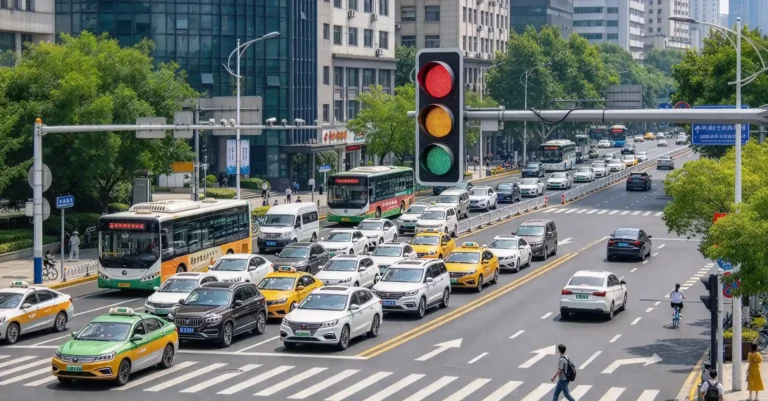
A good traffic light system does not only turn on red, yellow, and green lights. The system controls the flow of traffic, the movements of pedestrians, and traffic turns. Nevertheless, various intersections differ in their traffic situations. A busy urban intersection requires the dynamic control of lights, while a suburban intersection will work effectively with a preset plan. Knowledge of different types of Traffic Light Control Systems is important for traffic engineers, project managers, and equipment suppliers to choose the right system for specific roads.
1. What Is a Traffic Light Control System?
A Traffic Light Control System is an electronic or computer-based system that controls traffic lights at intersections. Such a system decides the timing of signal phases and manages the priority of vehicles, cyclists, and pedestrians. A standard traffic light control system consists of the following parts:
- Traffic signal controller: Processes timing plans or detector inputs and determines which lights should be active.
- Signal heads: Display red, yellow, and green indications to road users.
- Vehicle detectors: Identify approaching vehicles through technologies such as inductive loops, radar, or video detection.
- Communication equipment: Transfers information between intersection controllers and central traffic management platforms.
- Power supply and backup: Provides electrical power and may maintain operation during temporary power interruptions.
Timing of signalization usually comprises three crucial aspects, including cycle length, phase, and green time. Cycle length means the period of time needed for one signalization cycle. The cycle may take 60-120 seconds to be completed, but the time length varies depending on the traffic demand and geometry of an intersection. A properly designed Traffic Light Control System synchronizes all of the mentioned aspects to control conflicting movements safely.
2. What Are the Main Types of Traffic Light Control Systems?
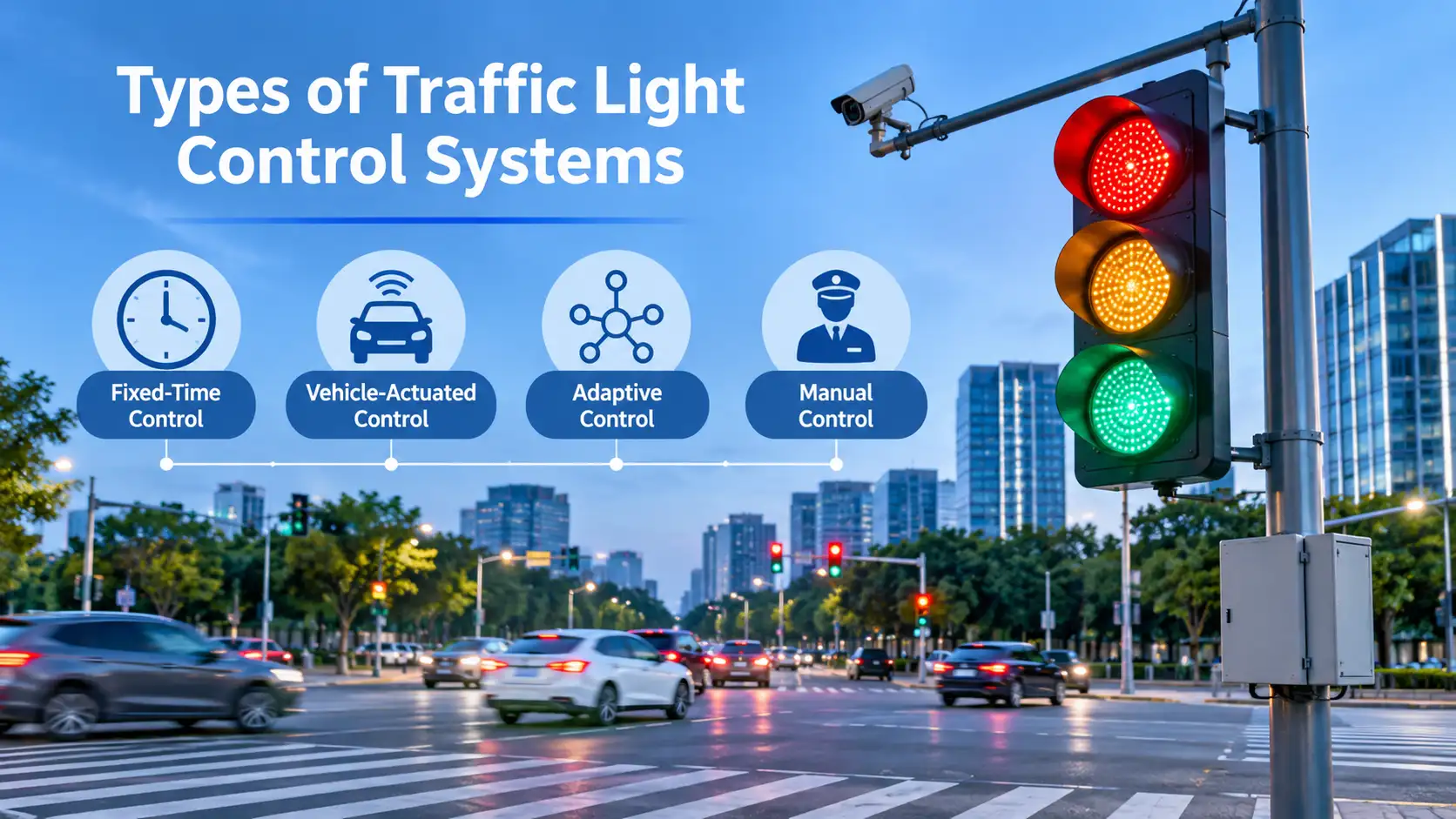
Traffic signals use different control methods depending on traffic volume, road layout, available technology, and management requirements. Four common types are fixed-time, vehicle-actuated, adaptive, and manual control.
Fixed-Time Traffic Light Control System
The fixed-time Traffic Light Control System works according to the programmed signal sequence. In this case, every phase gets its programmed time of green, yellow, and red periods irrespective of the presence of vehicles in front of the traffic light. For instance, the main road can get 30 seconds of green light, 5 seconds of yellow, and 25 seconds for the crossroad. The exact time depends on the programmed timing sequence and the requirement of safety.
Advantages:
- Simple programming and predictable operation.
- No vehicle detection equipment is required.
- Relatively straightforward installation and maintenance.
Limitations:
- Cannot respond directly to unexpected traffic changes.
- May waste green time when a road has few or no vehicles.
- Can cause longer queues during peak periods if timing is not adjusted.
Vehicle-Actuated Traffic Light Control System
The Vehicle-Actuated Traffic Light Control System varies the cycle timings depending on the demand for traffic detected at the intersection. The detectors sense any approaching or waiting vehicles, which then send data to the traffic light control system. Detection methods used in traffic light control systems include:
- Inductive loop detectors: Installed beneath the road surface to detect vehicles through changes in magnetic fields.
- Radar detectors: Use radio waves to identify vehicle presence, speed, and movement.
- Video detection: Uses cameras and image-processing software to monitor designated traffic zones.
If a vehicle is detected on one of the side roads, the traffic light control system will allocate time in the green state to that road depending on its programming. Some traffic light control systems have minimum and maximum green times, with a 10-second minimum before starting the process; if more vehicles are detected, the time increases until it reaches the programmed maximum.
Adaptive Traffic Light Control System
The Adaptive Traffic Light Control System makes use of real-time data to adapt its signal timing either continuously or frequently. Unlike the fixed-timed system that is dependent on time schedules, the adaptive system assesses traffic data at one or more intersections. The data gathered includes:
- Vehicle counts and traffic density.
- Queue length and average waiting time.
- Vehicle speed and turning movements.
- Traffic conditions at neighboring intersections.
An adaptive system analyzes real-time traffic data and adapts its signal timing to the changing needs. It will allocate more green time to the busy roads during peak times and still maintain traffic flow in other directions. This method applies to congested urban areas but needs effective communication networks and sensors.
Manual Traffic Light Control System
The manual Traffic Light Control System gives traffic officers the ability to control or manipulate traffic light signals if necessary. In contrast to the automated method, this process involves human decision-making depending on the condition of the roads or the traffic control plan. It is commonly used in situations such as:
- Road construction and temporary lane closures.
- Traffic accidents and emergency response.
- Sporting events, concerts, and large public gatherings.
- Temporary traffic restrictions or special vehicle movements.
This kind of system provides some flexibility if the regular scheduling of signals is not appropriate. This system needs proper personnel and procedures to be carried out. It is usually a short-term management solution.
| Control Type | Main Input | Key Advantage | Common Application |
| Fixed-Time | Preset timing plans | Simple and predictable | Stable traffic conditions |
| Vehicle-Actuated | Vehicle detection | Responds to traffic demand | Variable traffic volumes |
| Adaptive | Real-time traffic data | Adjusts to network conditions | Busy urban corridors |
| Manual | Operator decisions | Flexible intervention | Emergencies and special events |
3. What Should You Look for in a Traffic Light Control System?
Selecting the right Traffic Light Control System requires more than comparing equipment prices. Project planners should evaluate operating conditions, technical requirements, and long-term maintenance needs.
Traffic Volume and Road Conditions
Begin your examination by looking at average daily traffic, demand during the peak hour, turning movements, and pedestrians. A road that consistently has traffic can use fixed-time control, while an intersection that does not have constant demand may use vehicle actuation or adaptive control. Geometry of roads is another important aspect to consider. Factors like lanes, speed of approach, turning lanes, and distance between adjacent intersections affect signal timing requirements.
Detection and Communication Requirements
Vehicle actuation and adaptive control require traffic data. In purchasing traffic detectors, buyers need to consider their coverage distance, installation point, environmental resilience, and accuracy of data collected. Where there are many interconnected intersections, communication technologies like Ethernet, fiber optic, and wireless technology may be needed. The chosen devices need to accommodate this requirement.
Installation and Maintenance Costs
The first cost would comprise controllers, signal heads, detectors, cables, poles, and installation costs. However, the total cost of ownership also involves electricity costs, inspections, replacement parts, software upgrades, and technical support services. An upgraded system might have a higher initial cost, but the benefits may outweigh those costs if the traffic demand is complicated. Maintenance budgets need to consider hardware and software considerations as well.
System Compatibility and Future Expansion
A Traffic Light Control System needs to be capable of integration into existing traffic systems wherever feasible. Consider such issues as controller connectivity, communication protocols, monitoring systems, and the potential to expand the system in the future when a city decides to add detectors or connect other intersections.
Conclusion
Some of the major categories of traffic light control include fixed time control, vehicle-actuated control, adaptive control, and manual control. Different traffic light controls have different purposes. When assessing a Traffic Light Control System, some of the things you need to take into consideration are traffic volume, detection system, installation cost, compatibility, and potential for expansion.
0