目录
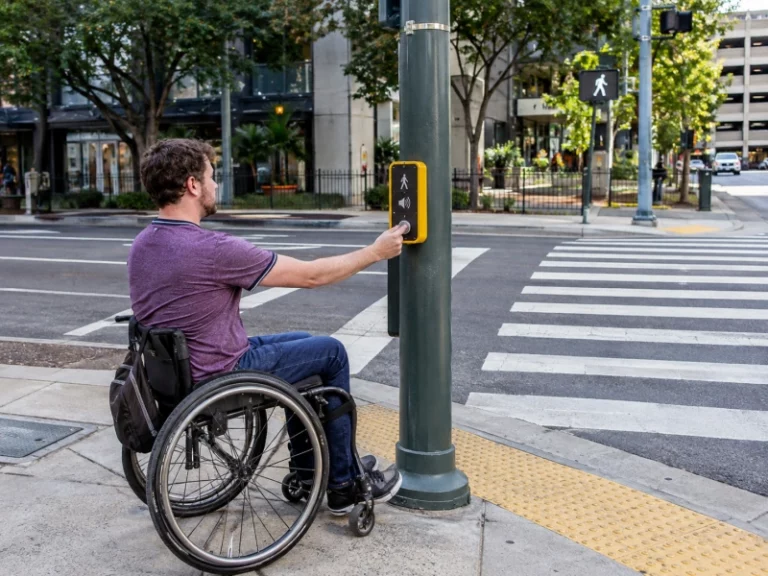
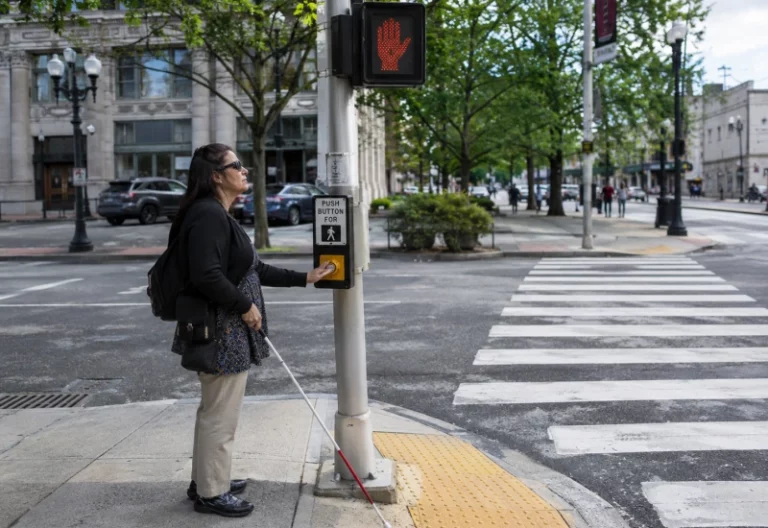
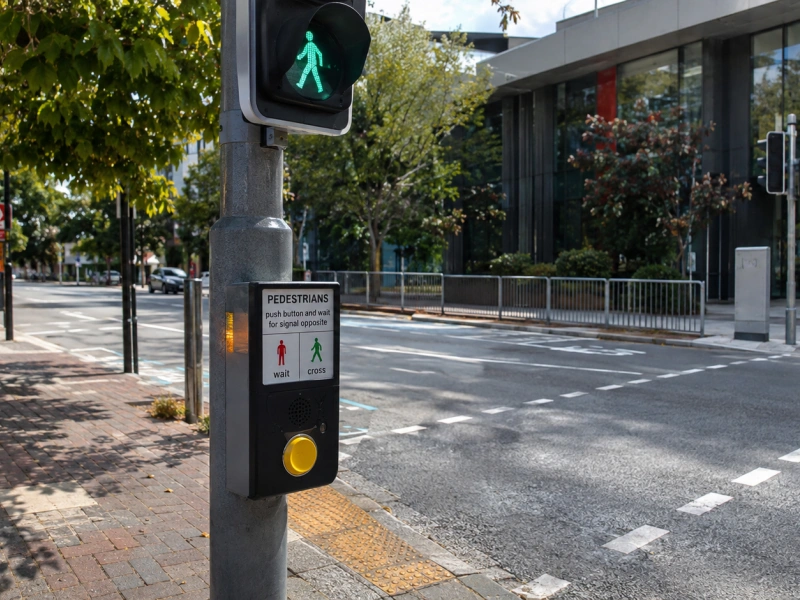
All intersections cannot be upgraded for accessibility at one time. Some have audible crossing signs and tactile push buttons; some don’t have those, and thus only visual signs of pedestrian crossings are present. Those who have visual problems may have a problem when they use intersections that don’t have APS.
While choosing the sites for installation of APS, it shouldn’t just be the width of the road; the number of vehicles passing by should also be considered.
1. Which Intersections Should Receive Accessible Pedestrian Signals First?
The intersections that have accessibility issues for pedestrians should be prioritized. Both on-site factors and those of individuals using such crossings should be considered by cities.
1. Complex Signalized Intersections
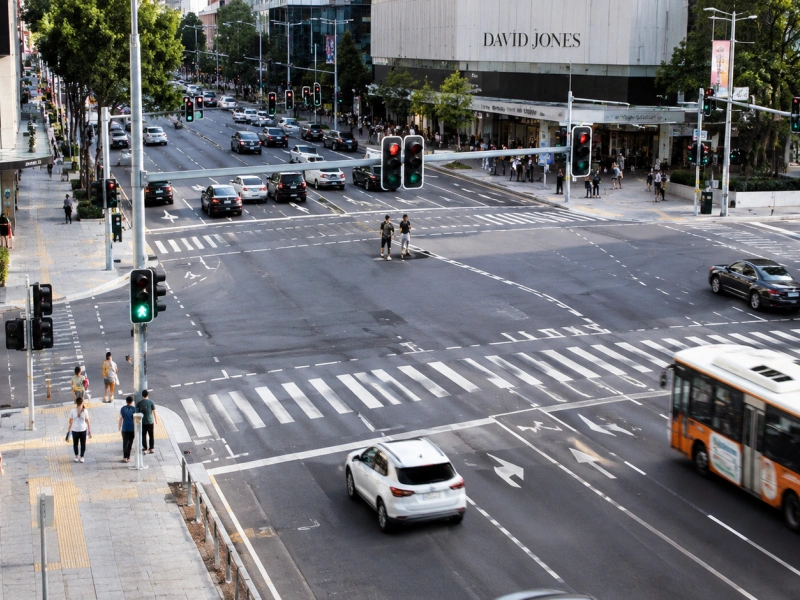
The presence of more than one turning lane, an unusual street geometry, and complicated signal timings can make it difficult for blind pedestrians to determine when to cross based on traffic sounds alone. The non-visual WALK message would be useful in this case.
2. Transit Facilities
Crosswalks near public transport stops, rail station entries, and transit facilities are normally used by pedestrians as their walking paths. Inaccessible crossing information would make it difficult for blind travelers to use such transit facilities.
3. Health Care and Public Service Buildings
The intersection near a hospital, rehab center, and other public service buildings should be assessed in terms of accessibility issues. This is based on the crossing situation and pedestrian needs instead of the type of building only.
4. Sites with Reported Accessibility Issues
Issues involving difficult-to-find push buttons, unclear WALK signals, or misleading crossing directions serve as useful documentation. These sites merit special consideration even though their features do not necessarily entail equal legal installation requirements.
1.1 How Can Cities Rank Intersections for APS Installation?
A weighted scoring method can help cities compare candidate intersections.
For example, a preliminary assessment might use the following criteria:
| Assessment Criterion | Illustrative Weight |
| Reported accessibility barriers and pedestrian feedback | 35% |
| Traffic and intersection complexity | 30% |
| Pedestrian activity and access to public facilities | 20% |
| Existing infrastructure and installation feasibility | 15% |
| Total | 100% |
Each criterion can be rated between 1 and 5, with a higher rating being associated with higher priority.
If an intersection obtains ratings of 5, 4, 4, and 3: Priority score = (5 × 0.35) + (4 × 0.30) + (4 × 0.20) + (3 × 0.15) = 4.20/5
This implies that the intersection is associated with relatively high priority.
These weightings are purely illustrative, and no official standardization exists. Adjustments can be made to fit local circumstances, although required accessibility modifications should never be deferred on account of a lower value. Button placements, controller availability, crossing geometries, and construction criteria must then be checked in a field inspection. Crossing distance counts too. For example, at the assumed rate of 1.07 meters per second (3.5 feet per second) walking speed, a 21-meter crossing will take about 19.6 seconds to cross. Again, this is merely a travel time calculation and does not constitute an exact timing requirement.
2. How Should Accessible Pedestrian Signals Be Set Up at Priority Intersections?
Having done this, APS installations must then be made based on the operating conditions at that intersection. Equipping all intersections with the same devices might not necessarily solve the problems faced by pedestrians.
2.1 Which Accessible Pedestrian Signal Features Matter Most?
APS devices give information in auditory form or through vibrations. Four features are especially important.
1. Auditory WALK indications
This gives pedestrians information about the pedestrian WALK phase. In cases where the signals have complicated phasing, this feature should clearly relate to the correct crossing direction.
2. Locator tones
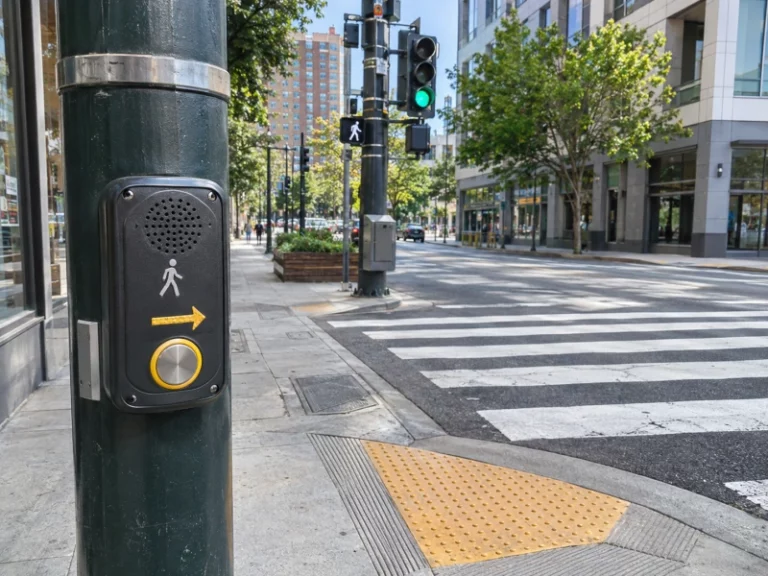
Locator tones allow pedestrians to identify the pushbutton. This is especially effective when the pushbutton is hard to locate, or there are several signal devices located nearby.
3. Tactile and Vibrotactile Indications
Tactile arrows are useful in detecting the direction of crossing, while vibrotactile indications offer information by tactile means. The orientation and operation of these devices should coincide with the crossing and signaling indications.
4. Adaptive Volume Control
Adaptive volume control varies sound output depending on background noise levels. This will help to ensure guidance when conditions are noisy, and to minimize extra noise in silent times.
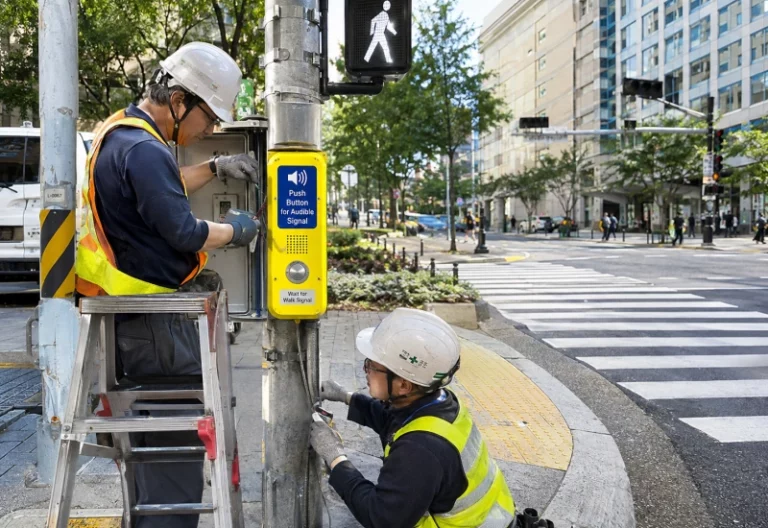
Sinowatcher’s Xentra Acoustic Guidance Unit for Accessible Pedestrian Signal Systems (APSS) serves as a good illustration. The pole-mounted device offers both audible localization and configurable crossing warnings. The device allows adaptive volume setting and works with Xentra pedestrian push buttons; thus, it is appropriate for installation in urban crossings and intersections controlled by traffic signals.
The acoustic guidance unit is part of an APS system installation, rather than a substitute for all the components of the system.
2.2 What Should Cities Check Before and After Installation?
This is just one step in the process. Proper installation and testing are needed to ensure that the crossing information continues to be accurate.
Before installation:
• Button placement: Ensure that pedestrians have access to and can find the button, as well as that their placement meets any accessibility criteria.
• Controller compatibility: Ensure that the APS equipment can receive the proper pedestrian signal information.
• Background noise: Check traffic noise during peak times and off-peak times to determine what type of sound settings and equipment placement are appropriate.
Post-Installation:
• Auditory Information: Make sure the “WALK” signs are audible concerning the control of traffic signals.
• Directional Information: Make sure the tactile arrows are pointing in the direction in which the pedestrians move.
• Functioning of Buttons: Make sure the buttons operate correctly.
• Maintenance: Check the condition of the speakers, buttons, and their connections for any malfunctions and incorrect adjustments. The upgrade can be done simultaneously with that of the road and traffic lights to save the effort of reconstructions every time. Nevertheless, it must be done according to the standards of accessibility.
Conclusion
Priority should be given to APS installations at intersections with known barriers, complex traffic conditions, and important public transportation connections. In assessing priority, pedestrian input, intersection characteristics, accessibility criteria, and installation feasibility must all be considered. After determining priority, appropriate equipment and testing will be necessary. The point of APS planning is not just to put up more APSs, but rather to eliminate the barriers to safe and independent crossing.
0