目录
The transflective LCD is a display technology designed to remain clearly visible even under strong sunlight, making it ideal for outdoor use. Unlike traditional LCDs that become hard to read in bright conditions, it uses both reflective and transmissive modes to take advantage of ambient light while still supporting backlighting. This allows it to deliver clear images in both bright and low-light environments while also improving energy efficiency. As a result, transflective LCDs are widely used in transportation, industrial equipment, marine systems, and outdoor electronic devices where stable visibility is essential.
The Role of Reflective and Transmissive Technology
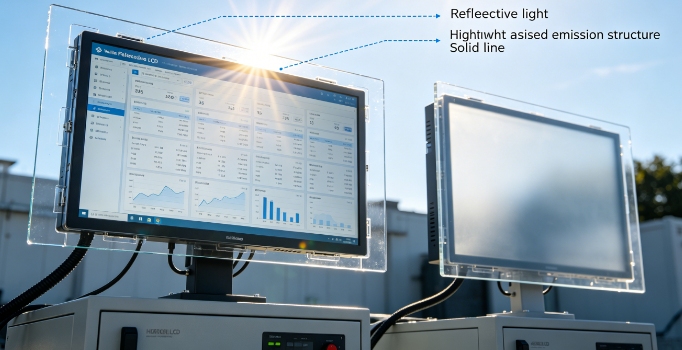
The key reason a transflective LCD performs well in sunlight is its hybrid optical design, which combines two different methods of light handling.
- Reflective functionality: In bright environments, the display reflects ambient light toward the user, improving readability without depending entirely on backlighting.
- Transmissive Function: In dim environments, the screen switches to backlight mode to ensure that images remain clearly visible.
- Balanced light control: The display intelligently combines reflected light and transmitted light to create stable contrast levels.
- Reduced washout effect: Traditional LCDs often appear faded under sunlight, while this design minimizes that problem by enhancing natural light usage.
This dual-function structure allows the transflective LCD to remain readable in outdoor conditions where standard displays often fail.
How Ambient Light Improves Screen Clarity
Unlike conventional screens that struggle against sunlight, this technology is designed to benefit from ambient light exposure.
Key sunlight visibility mechanisms include:
- Utilizing external light sources
Far from blocking sunlight, this display captures and reflects it, thereby enhancing both brightness and readability. - Enhancing contrast in daylight
Strong ambient light increases the reflective effect, making text and graphics appear sharper. - Reducing dependency on maximum brightness
Since the display uses sunlight itself, there is less need for extremely powerful backlighting. - Improving readability from different viewing angles
Outdoor users can often read the display more clearly, even when viewing conditions are less than ideal.
These features help the transflective LCD maintain strong visual performance under intense sunlight conditions.
Energy Efficiency and Heat Reduction Benefits
Improved sunlight visibility is closely connected to energy efficiency, which is another major advantage of the transflective LCD.
- Lower backlight power usage: Because ambient light contributes to visibility, the display can operate with reduced backlight intensity.
- Extended battery performance: Portable outdoor devices benefit from longer operating times between charges.
- Reduced internal heat generation: Lower backlight demand decreases heat buildup inside the device.
- Stable outdoor operation: Less heat stress helps improve system reliability during long hours of sunlight exposure.
These energy-saving features make this technology particularly practical for field equipment and battery-powered outdoor electronics.
Real-World Outdoor Applications
Transflective LCDs feature a sunlight-readable design, making them highly valuable in numerous industries that require reliable outdoor visibility.
- Industrial machinery displays: Construction and agricultural equipment use these screens for real-time monitoring in open environments.
- Transportation dashboards: Vehicles, trains, and marine systems rely on readable displays regardless of sunlight intensity.
- Portable GPS and navigation systems: Outdoor navigation devices require screens that remain visible without draining battery life quickly.
- Military and emergency equipment: Tactical gear and rescue devices frequently need to function in varying and unpredictable outdoor lighting environments.
These application cases demonstrate why this technology is highly favored in environments where requirements for visibility and reliability are critical.
Comparison With Traditional LCD Screens
Compared to standard LCDs, transflective LCDs offer several advantages in terms of display performance under sunlight.
- Better daylight readability: Traditional LCDs often appear washed out under direct sunlight, while transflective screens become clearer.
- Reduced glare sensitivity: The reflective layer helps control brightness and contrast more effectively outdoors.
- Lower power requirements: Standard displays usually need stronger backlights to remain visible in sunlight.
- More Adaptive Operation: The display enables smoother switching between outdoor and indoor environments.
Although traditional LCDs may offer richer color indoors, the transflective LCD is generally more effective in bright outdoor conditions.
Conclusion
The transflective LCD improves visibility in bright sunlight by combining reflective and transmissive technologies to make effective use of ambient light. Instead of relying entirely on backlighting, it reflects external light to enhance contrast and readability, reducing glare and minimizing the washed-out appearance common in traditional LCD screens. This approach not only improves outdoor visibility but also lowers power consumption and heat generation, making it highly suitable for industrial equipment, transportation systems, navigation devices, and portable electronics. As the demand for reliable outdoor display technology continues to grow, the transflective LCD remains one of the most practical solutions for maintaining clear screen performance under strong sunlight conditions.
0