目录
In today’s highly competitive manufacturing landscape, companies are constantly seeking various avenues to optimize packaging costs without sacrificing quality or brand impact. One increasingly popular solution is in mold labeling, a technology that integrates labels directly into the injection molding process so that decoration and product formation happen simultaneously. Unlike traditional labeling methods that require multiple post-processing steps, in mold labeling streamlines production and reduces waste, making it a highly cost-efficient approach for large-scale manufacturing. Its ability to combine aesthetics, durability, and efficiency has made it a preferred choice in industries such as food packaging, household goods, and consumer products.
1. Eliminating Extra Production Steps and Labor Costs
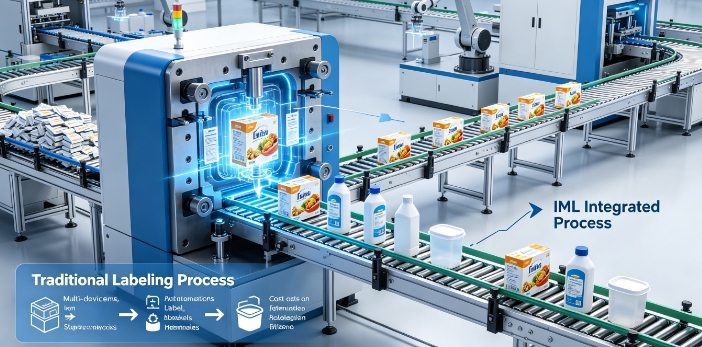
One of the most direct ways in which in-mold labeling reduces packaging costs is by eliminating the multiple independent production stages required in traditional labeling systems.
- Traditional packaging requires printing labels, applying adhesives, and then manually or mechanically attaching labels to finished products, all of which add labor expenses.
- With IML, the label is placed inside the mold before injection, allowing the labeling process to occur automatically during molding.
- This integration reduces the need for multiple machines and operators, lowering equipment investment and staffing requirements.
- It also minimizes production coordination between different departments, reducing management overhead and workflow delays.
By simplifying the entire labeling process, manufacturers can significantly reduce operational costs and improve efficiency.
2. Reducing Material Consumption and Waste Generation
Another significant cost-saving factor of in-mold labeling lies in its efficient utilization of materials, which helps reduce waste and unnecessary expenses.
- The process eliminates the need for additional adhesives or glue materials, reducing chemical procurement costs.
- Labels are precisely pre-cut and positioned in the mold, which significantly lowers the risk of misalignment or defective labeling.
- Because labels are fused with the product surface, there is almost no risk of peeling, which reduces product rejection rates.
- Manufacturing waste from damaged or improperly labeled products is minimized, leading to better material utilization efficiency.
These improvements make production more sustainable while also lowering overall packaging material costs.
3. Increasing Production Efficiency and Reducing Unit Costs
In mold labeling also contributes to cost reduction by improving production speed and efficiency, which directly lowers the cost per unit.
- Labeling is completed within the molding cycle, meaning decoration and product formation happen at the same time.
• Faster cycle times increase daily output, allowing manufacturers to produce more units with the same resources.
• Automation reduces human error, which decreases the need for rework and quality control interventions.
• Continuous production flow minimizes downtime between labeling and molding processes, improving overall factory utilization.
Higher efficiency results in better economies of scale, which is crucial for large-volume packaging production.
4. Enhancing Product Durability and Reducing Replacement Costs
Long-term savings are also achieved because in mold labeling significantly improves product durability, reducing the need for repairs, replacements, or relabeling.
- Labels are embedded into the product surface, making them highly resistant to scratching, moisture, and chemical exposure.
- Packaging maintains its appearance throughout the entire product lifecycle, even under harsh handling conditions.
- Reduced label damage means fewer returned or discarded products due to branding or compliance issues.
- Strong adhesion eliminates the risk of peeling, which is common in traditional adhesive labeling methods.
This durability reduces post-production losses and helps companies maintain consistent product quality.
5. Optimizing Storage, Inventory, and Logistics Costs
In addition to saving on production costs, in-mold labeling can also help reduce warehousing and logistics costs by simplifying the packaging supply chain.
- Manufacturers do not need to store large inventories of separate labels, reducing warehouse space requirements.
• Integrated production reduces the number of packaging components that must be managed and tracked.
• Simplified supply chains lower the risk of delays caused by missing or mismatched labeling materials.
• Lighter and more integrated packaging designs can reduce transportation and handling costs.
These logistical improvements contribute to a more efficient and cost-effective overall operation.
Conclusion
In conclusion, in mold labeling helps reduce packaging costs by eliminating extra production steps, minimizing material waste, improving production efficiency, enhancing product durability, and optimizing storage and logistics processes. By integrating labeling directly into the molding process, manufacturers can achieve significant savings while maintaining high-quality packaging standards. As industries continue to prioritize cost control and operational efficiency, in mold labeling stands out as a powerful solution for modern packaging production.
0