目录
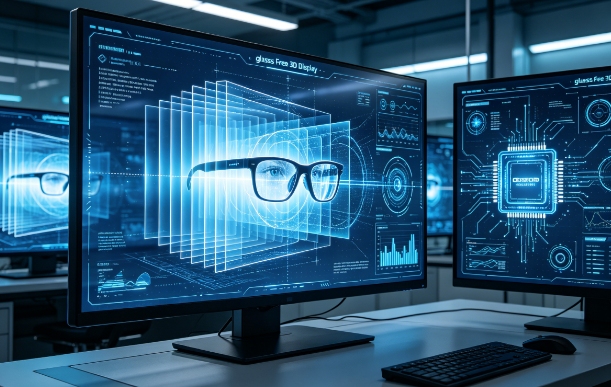
As display technology continues to advance, immersive visual experiences have become a major focus in consumer electronics, advertising systems, and professional visualization tools. Among these innovations, the glasses free 3d display stands out as a breakthrough that enables users to experience three-dimensional visuals without wearing special eyewear. Unlike traditional 3D systems that rely on glasses to separate images for each eye, this technology uses advanced optical and computational methods to deliver depth perception directly from the screen. Understanding the core technologies behind a glasses free 3d display helps explain how it creates realistic 3D effects and why it is becoming increasingly important in modern devices.
Optical Layer Technologies: The Foundation of 3D Depth
At the core of every glasses free 3d display is an optical structure that directs light differently to each eye, creating the illusion of depth.
- Lenticular lens arrays: These are fine cylindrical lenses placed over the screen surface that split images into multiple viewing angles, allowing different perspectives to reach each eye.
- Parallax barrier systems: A precision layer with microscopic slits blocks and guides light so that each eye sees a slightly different image, producing stereoscopic depth.
- Multi-view rendering design: Instead of showing a single image, the display generates multiple views of the same scene for different angles.
- Directional light control: Advanced optical films help control light distribution, ensuring smooth transitions between viewing zones.
These optical technologies form the physical foundation that makes glasses-free 3D perception possible.
Computational Imaging and Rendering Technology
Behind the visual output of a glasses free 3d display lies complex computational processing that generates multiple image perspectives in real time.
- Multi-view image generation: The system creates several slightly shifted images of the same scene to simulate depth from different angles.
- Real-time rendering engines: High-performance GPUs process 3D content dynamically, ensuring smooth playback without lag.
- Depth mapping algorithms: Software analyzes object distances and constructs spatial relationships within the scene.
- Image synchronization systems: Ensure that all visual layers are aligned correctly for each viewing angle to avoid distortion.
These computational techniques ensure that the visual output remains stable, realistic, and responsive.
Eye-Tracking and Adaptive Viewing Technology
Modern glasses free 3d display systems often include intelligent tracking technologies to improve viewing accuracy and comfort.
- Real-time eye tracking sensors: Cameras or infrared sensors detect the viewer’s eye positions to adjust image alignment dynamically.
- Adaptive viewing zone adjustment: The display recalibrates 3D perspectives based on user movement for consistent depth perception.
- Personalized visual rendering: Some systems optimize image delivery based on individual viewing distance and angle.
- Reduced image crosstalk: Eye-tracking helps minimize overlap between left-eye and right-eye images, improving clarity.
These features significantly enhance the stability and realism of the 3D effect, especially in dynamic environments.
High-Resolution Display Panels and Hardware Integration
The performance of a glasses free 3d display also depends heavily on the quality of its hardware components, especially the screen panel itself.
- Ultra-high-resolution panels:4K and beyond resolution is often required to maintain image clarity when splitting visuals into multiple views.
- High refresh rate technology: Smooth motion rendering is essential for maintaining depth perception without flickering or lag.
- Fast response time screens: Reduce motion blur during fast-moving 3D content such as games or simulations.
- Integrated processing units: Dedicated chips handle 3D rendering and optical adjustments in real time.
Without strong hardware support, even advanced optical systems cannot deliver a high-quality 3D experience.
Software Ecosystem and Content Optimization
A critical part of glasses free 3d display technology is the software that adapts content for 3D viewing environments.
- 3D content conversion tools: Software converts standard 2D images and videos into multi-view 3D formats.
- Engine compatibility with design tools: Integration with modeling and animation software allows creators to produce native 3D content.
- Real-time content optimization: Algorithms adjust brightness, contrast, and depth levels based on display conditions.
- Cross-platform support: Ensures compatibility across entertainment, education, and industrial applications.
This software layer bridges the gap between raw hardware capability and practical user experience.
Conclusion
In conclusion, a glasses free 3d display is powered by a combination of advanced optical structures, computational imaging, eye-tracking systems, high-resolution hardware, and intelligent software ecosystems. Each technology plays a critical role in delivering realistic depth perception without the need for special eyewear. From lenticular lenses and parallax barriers to real-time rendering engines and adaptive viewing systems, these innovations work together to create immersive visual experiences. As these technologies continue to evolve, glasses-free 3D displays are expected to become more accurate, accessible, and widely adopted across industries such as entertainment, education, and professional visualization.
0