
目录
Selecting appropriate educational toys is crucial for supporting children’s cognitive, emotional, and physical development at various stages of growth. As children grow, their learning needs, attention span, and motor skills change significantly. A well-selected toy can help improve creativity, problem-solving ability, and hand-eye coordination while keeping learning fun and engaging. However, with so many products available on the market, especially from different educational toy manufacturer sources, parents often find it difficult to make the right decision. Recognizing features suitable for different age groups is essential for making effective choices.
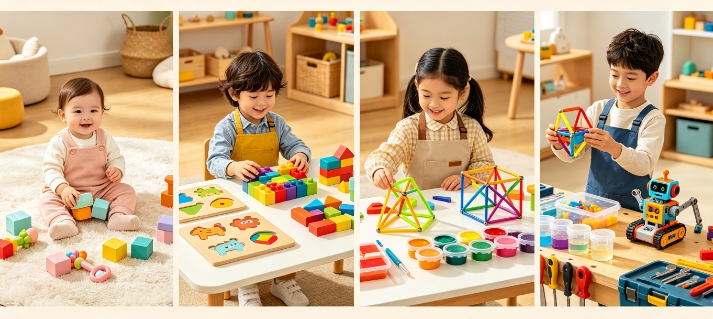
Educational Toys for Infants (0–2 Years)
At this stage, children are mainly developing sensory awareness and basic motor skills. Priority should be given to the stimulating nature, safety, and simplicity of toys.
- Soft texture and safe materials: Toys such as fabric blocks, rubber rings, and plush items help infants explore different textures without risk of injury.
- High-contrast visual stimulation: Black-and-white or brightly colored toys attract attention and support early visual development.
- Sound-based interaction: Rattles or musical toys help babies recognize sound patterns and improve auditory response.
- Simple grasping functions: Lightweight toys that are easy to hold support early hand coordination and muscle development.
For this age group, safety and sensory stimulation are the most important factors.
Educational Toys for Toddlers (2–4 Years)
Toddlers are highly active and curious, so toys should support movement, imagination, and early learning concepts.
- Building and stacking toys: Blocks and simple construction sets improve fine motor skills and spatial awareness.
- Basic learning tools: Alphabet puzzles, number boards, and shape sorters introduce early cognitive concepts.
- Role-play toys: Mini kitchen sets or tool kits encourage imagination and social behavior development.
- Interactive play features: Toys with buttons, sounds, or light effects help maintain attention and improve hand-eye coordination.
At this stage, toys should balance fun and foundational learning skills.
Educational Toys for Preschoolers (4–6 Years)
Preschool children are ready for more structured learning and problem-solving activities.
- Advanced puzzle games: Jigsaw puzzles with more pieces help develop logical thinking and patience.
- Early STEM toys: Simple science kits or magnetic building sets introduce basic engineering and discovery skills.
- Creative art tools: Drawing boards, clay kits, and craft sets enhance imagination and artistic expression.
- Group activity toys: Board games encourage cooperation, sharing, and social interaction.
Parents often rely on guidance from a professional educational toy manufacturer to select age-appropriate, skill-building products at this stage.
Educational Toys for School-Age Children (6+ Years)
Older children can benefit from toys that challenge their thinking, creativity, and academic skills.
- STEM and robotics kits: These help develop logical reasoning, coding basics, and engineering thinking.
- Strategy-based board games: Games that require planning and decision-making improve critical thinking skills.
- Language and math learning tools: Interactive learning systems support academic performance in school subjects.
- Creative project kits: DIY models and science experiments encourage independent exploration.
At this stage, toys should be more complex and intellectually stimulating.
Key Factors When Selecting Educational Toys
Regardless of age, there are important considerations to ensure safety and learning effectiveness.
- Safety standards compliance: Always check for non-toxic materials and certifications to ensure child safety.
- Age-appropriate design: Toys must match developmental stages to avoid frustration or lack of engagement.
- Durability and quality: High-quality materials ensure longer usage and better value for money.
- Clear Learning Objectives: Each toy should possess a distinct educational function—whether cognitive, physical, or emotional.
Working with a reliable educational toy manufacturer can help ensure product quality and educational value.
Conclusion
In summary, choosing the right educational toy depends heavily on the child’s age and developmental needs. From sensory toys for infants to STEM kits for older children, each stage requires different types of stimulation and learning support. Parents should focus on safety, functionality, and age suitability when making selections. With proper guidance and high-quality products from trusted sources, educational toys can play a powerful role in shaping a child’s learning journey and overall development.
0