目录
As electric vehicles (EVs) continue to expand globally, understanding different charging standards becomes essential for EV owners. Among the most commonly used options in Europe and many other regions are the CCS2 charging cable and the Type 2 charging cable. While they may appear similar at first glance, they serve different purposes and offer distinct advantages. Knowing the key differences can help you choose the right charging solution for your vehicle and improve your overall charging experience.
1. CCS2 Charging Cable: Features and Advantages
The CCS2 charging cable (Combined Charging System Type 2) is designed for fast and ultra-fast charging, making it a preferred choice for modern electric vehicles.
- Integrated charging system: CCS2 combines both AC and DC charging in one connector, allowing drivers to use the same port for multiple charging types. This reduces the need for multiple cables and simplifies the charging process.
- High charging speed: One of the biggest advantages is its ability to support high-power DC fast charging, often reaching up to 350 kW, depending on the station and vehicle. This means significantly shorter charging times compared to traditional methods.
- Wider compatibility with fast chargers: CCS2 is commonly used across Europe and is supported by most new EV models, making it a future-proof solution for long-distance travel and public fast-charging networks.
- Advanced communication system: The cable includes built-in communication between the car and charging station, ensuring safe and efficient energy transfer, which enhances battery protection and charging optimization.
2. Type 2 Charging Cable: Features and Applications
The Type 2 charging cable is widely used for standard AC charging, especially at home and workplace charging stations.
- AC charging focus: Unlike CCS2, the Type 2 cable is primarily used for alternating current (AC) charging, which is slower but suitable for overnight charging at home.
- Widely adopted standard: It is the standard connector in Europe for AC charging, and many public charging stations are equipped with Type 2 sockets.
- Slower charging speed: Charging speeds typically range from 3.7 kW to 22 kW, which is significantly slower than CCS2 DC fast charging but sufficient for daily commuting needs.
- Simple and cost-effective: Type 2 charging infrastructure is generally more affordable and easier to install, making it a popular choice for residential and commercial setups.
3. CCS2 Charging Cable vs Type 2 Charging Cable: Key Differences
Understanding the differences between these two cables helps EV users make informed decisions based on their driving habits and charging needs.
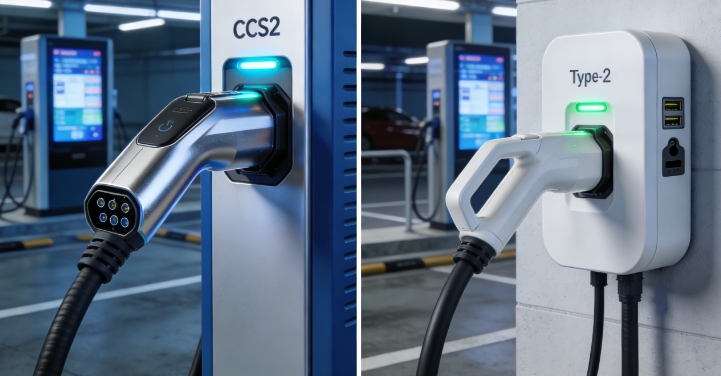
- Charging type: CCS2 supports both AC and DC charging, while Type 2 is limited to AC charging only. This makes CCS2 more versatile for various charging scenarios.
- Charging speed comparison: The CCS2 charging cable offers significantly faster charging, especially for long-distance travel, whereas Type 2 is better suited for slow, overnight charging.
- Connector design: CCS2 features additional DC pins beneath the Type 2 connector, making it larger and more advanced in functionality. Type 2 has a simpler structure with only AC charging pins.
- Usage scenarios: CCS2 is commonly used at high-speed public charging stations, while Type 2 is more often found in home charging setups and workplace chargers.
- Vehicle compatibility: Most modern EVs support CCS2 for fast charging, but many still use Type 2 for daily AC charging, making both standards complementary rather than competing.
4. Which Charging Cable Should You Choose?
Choosing between a CCS2 charging cable and a Type 2 charging cable depends on your usage habits and charging environment.
- If you frequently travel long distances or rely on public fast charging, the CCS2 cable is essential due to its high-speed capabilities.
- If your primary charging method is at home and you have ample time for charging, a Type 2 cable is sufficient and more cost-effective.
- Many EV owners use both cables: Type 2 for daily charging and CCS2 for fast charging on the go. This combination ensures maximum flexibility and convenience.
- Consider your vehicle’s compatibility, as not all EVs support DC fast charging via CCS2, especially older models.
Conclusion
In summary, the CCS2 charging cable and Type 2 charging cable serve different but complementary roles in the EV ecosystem. CCS2 focuses on fast, high-power charging for efficiency and long-distance travel, while Type 2 provides reliable, slower AC charging for everyday use. Understanding the differences between them allows EV owners to optimize their charging strategy, improve convenience, and make the most of available charging infrastructure.
0