目录
In the semiconductor, photovoltaic, and MEMS industries, selecting the right silicon wafer supplier is a critical decision that directly affects device performance, manufacturing yield, and long-term supply chain stability. Silicon wafers serve as the foundational material for advanced technologies, and even small variations in wafer quality can lead to high downstream costs. Whether you are a high-volume manufacturer or a research-driven organization. Conducting a structured evaluation of a silicon wafer supplier is essential for building a reliable and sustainable partnership.
1. Product Quality and Technical Specifications
Product quality is the most fundamental criterion when evaluating a silicon wafer supplier. High-quality wafers help reduce process variability, improve yield, and minimize the risk of rework or device failure.
- Crystal orientation: Common orientations such as ⟨100⟩ and ⟨111⟩ must be precisely controlled. A reliable silicon wafer supplier ensures minimal orientation deviation to support stable lithography, etching, and epitaxial processes.
- Doping type: The supplier should consistently provide both N-type and P-type wafers with uniform dopant distribution, preventing electrical performance fluctuations across the wafer or between batches.
- Resistivity range: Clearly defined and tightly controlled resistivity ranges are essential to meet the requirements of different applications, including power devices, logic ICs, and sensor technologies.
- Thickness tolerance: Consistent wafer thickness and tight tolerances are critical for downstream thinning, polishing, and packaging processes, especially in high-volume manufacturing.
- Flatness control: Parameters such as TTV, warp, and bow directly influence advanced process compatibility, making flatness control a key indicator of wafer processing capability.
- Surface quality: Low surface roughness, strict particle control, and high cleanliness levels are necessary to ensure reliable thin-film deposition and device performance.

2. Manufacturing Capability and Process Technology
Manufacturing capability reflects the overall strength of a silicon wafer supplier and determines long-term supply reliability.
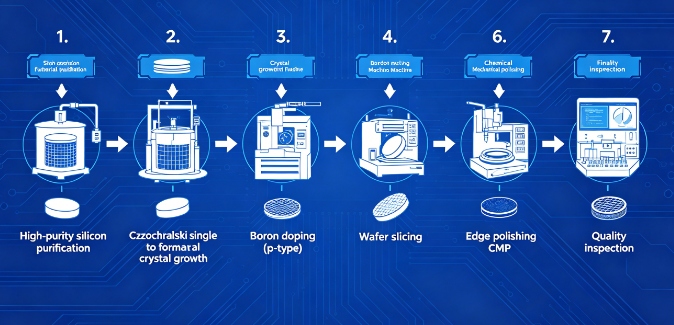
- Process coverage: The ability to control core processes such as crystal growth, slicing, lapping, polishing, or epitaxy helps ensure consistent wafer quality and process repeatability.
- Wafer size support: Stable production of 4-inch, 6-inch, 8-inch, and 12-inch wafers indicates advanced equipment infrastructure and technical maturity.
- Wafer grades: A qualified silicon wafer supplier should clearly differentiate and reliably supply prime, test, dummy, and monitor wafers to support both mass production and R&D needs.
- Customization ability: Support for special thicknesses, double-side polishing, ultra-thin wafers, or application-specific specifications highlights technical flexibility and customer focus.
3. Supply Stability and Lead Time Reliability
In an industry characterized by cyclical demand and supply fluctuations, supply stability has become a decisive factor when choosing a silicon wafer supplier.
- Raw material sourcing: Access to stable and sustainable sources of single-crystal or polycrystalline silicon reduces upstream risk and enhances supply continuity.
- Production capacity: Adequate and scalable production capacity allows the silicon wafer supplier to maintain consistent output during demand surges or market constraints.
- Lead time clarity: Transparent and predictable lead times enable customers to plan production schedules and inventory more effectively.
- Emergency response: The ability to respond quickly to urgent or unexpected orders reflects operational flexibility and strong coordination capabilities.
4. Industry Experience and Customer References
Industry experience demonstrates how well a silicon wafer supplier understands real-world applications and customer requirements.
- Industry coverage: Long-term service to semiconductor, power device, MEMS, or photovoltaic markets indicates adaptability to diverse technology roadmaps.
- Customer profile: Collaboration with fabs, IDMs, or research institutions often signals that the supplier’s products and processes have passed rigorous validation.
- Application understanding: A deep understanding of electrical, mechanical, and reliability requirements across different applications allows the supplier to provide practical recommendations.
5. Quality Management and Certifications
A structured quality management system is essential for a dependable silicon wafer supplier.
- Quality certifications: Certifications such as ISO 9001 and ISO 14001 indicate compliance with internationally recognized quality and environmental management standards.
- Inspection system: Comprehensive inspection at incoming, in-process, and outgoing stages ensures wafers consistently meet specified requirements.
- Traceability: Lot-level traceability enables rapid issue identification and minimizes the impact of potential quality concerns.
- Corrective action: Well-defined feedback and continuous improvement mechanisms demonstrate a commitment to long-term quality performance.
6. Price and Overall Value
Price is an important consideration, but it should be evaluated in the context of total value when selecting a silicon wafer supplier.
- Product yield: Higher wafer quality and yield directly reduce manufacturing losses and overall production cost.
- Delivery reliability: Consistent delivery performance minimizes downtime and inventory pressure.
- Service level: Strong technical and after-sales support adds long-term operational value.
- Long-term cost: Evaluating the total cost of ownership often reveals greater savings than focusing solely on unit price.
Conclusion
Choosing the right silicon wafer supplier requires a comprehensive evaluation of multiple factors. Including product quality, manufacturing capability, supply stability, and technical support. Each of these elements plays a critical role in ensuring consistent wafer performance and minimizing risks across the production lifecycle. A reliable silicon wafer supplier not only delivers wafers that meet exact specification requirements but also maintains process consistency, predictable lead times, and responsive technical communication.
0