目录
In modern fiber optic and structured cabling systems, understanding the differences between trunk and patch solutions is essential for building efficient and scalable networks. As data traffic continues to grow, enterprises, data centers, and telecom operators increasingly rely on optimized cabling architectures to ensure high-speed connectivity and simplified management. Choosing the right components not only impacts performance but also influences installation cost, maintenance efficiency, and long-term scalability. Many engineers also consider working with a reliable trunk cable manufacturer to ensure product quality and system compatibility in high-density environments.
Basic Structure and Design Differences
Trunk cables and patch cables differ significantly in design, which directly affects how they are used in fiber networks.
- Trunk cable design
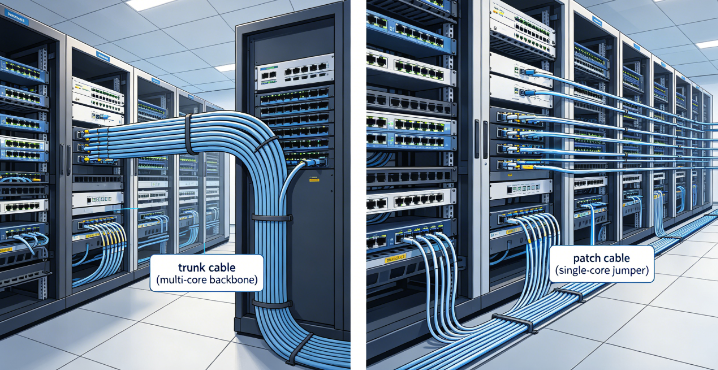
A trunk cable typically contains multiple fibers bundled into a single jacket with multi-fiber connectors such as MPO/MTP. It is designed for high-density backbone connections and is often pre-terminated to reduce installation time. - Patch cable design
Patch cables usually consist of a single fiber or a duplex pair with LC, SC, or ST connectors on both ends. They are flexible, lightweight, and used for short-distance connections between devices. - Structural impact on deployment
The bundled nature of trunk cables reduces cable clutter, while patch cables offer greater flexibility for individual port-level connections in network racks.
Application Scenarios in Network Systems
The usage scenarios of these two cable types highlight their functional differences in real-world environments.
- Trunk cable in backbone systems
In large-scale data centers, trunk cables are commonly used to connect distribution racks, patch panels, and core switches, enabling high-density fiber transmission across long distances within facilities. - Patch cable in device-level connections
Patch cables are typically used to connect servers, switches, and optical transceivers within racks, providing quick and flexible connectivity between individual devices. - Operational environment considerations
While trunk cables are optimized for structured and permanent installations, patch cables are ideal for frequent adjustments, testing, and reconfiguration scenarios.
Performance, Scalability, and Efficiency Comparison
When comparing performance, trunk and patch cables serve different roles in ensuring network efficiency and scalability.
- High-capacity transmission in trunk cables
Trunk cables support multiple fibers in a single assembly, making them ideal for 40G, 100G, and even higher-speed parallel optical systems. - Flexibility of patch cables
Patch cables provide point-to-point connections with lower fiber counts, making them easier to replace and rearrange without affecting the overall network structure. - Scalability considerations
Systems built with trunk cables scale more efficiently in high-density environments, while patch cables are better suited for incremental or modular expansions.
Installation, Maintenance, and Cost Factors
Installation complexity and maintenance requirements are key factors when choosing between trunk and patch cables.
- Reduced installation time for trunk systems
Pre-terminated trunk assemblies significantly reduce field termination work, minimizing labor costs and installation errors. - Simplified maintenance using patch cables
Patch cables can be easily swapped or rerouted, making troubleshooting and upgrades more convenient for technicians. - Cost efficiency balance
Although trunk cable systems may have a higher initial investment, they often reduce long-term operational costs. Working with a qualified trunk cable manufacturer can further optimize cost-performance balance through customized solutions.
Conclusion
In summary, trunk cables and patch cables serve different but complementary roles in fiber optic infrastructure. Trunk cables are designed for high-density backbone connectivity, offering scalability and efficiency in large-scale networks, while patch cables provide flexible, device-level connections for operational convenience. Understanding their differences allows network designers to build more structured and efficient systems. Selecting high-quality components and partnering with a reliable trunk cable manufacturer ensures long-term stability, performance, and scalability in modern fiber networks.
0