目录
In the case of upgrading an LED streetlight, it is important to develop a process to identify parts that can still be used. The status of the driver, the control interface, the wires, and the fixture will show whether this smart lighting solution will have to include new control nodes, a new driver, or a fixture replacement.
In order to make a smart LED street light, it is crucial to identify all tasks that this device has to perform, such as dimming scheduling, remote switching, and fault signaling. It is important to check the compatibility of the proposed solution and carry out tests.
1. What Does a smart LED street light Upgrade Require?
A Driver That Supports the Intended Controls
Conversion of the input power to the electrical form that is needed by the LED module will be done through the LED driver. Although a simple driver will turn on/off, it will not dim. Please consult the manual to confirm whether it has 0-10V, DALI, or PWM interfaces, and check for the correct control cables. The interfaces differ, and none can replace another. For example, the 0-10V interface uses analog signals while the DALI interface uses digital signals. It is therefore necessary that the controller has the same interface as the driver.
Compatible Sockets, Wiring, and Power
An existing NEMA or Zhaga socket can simplify installation, but matching connector shapes do not guarantee functional compatibility.
| Item | What to verify |
| Dimming interface | Controller output matches the driver input |
| Socket and wiring | Pin functions and internal connections are correct |
| Node power supply | Voltage and available power meet requirements |
| Management platform | Selected devices and required functions are supported |
A node that physically fits may still be unable to report energy consumption, identify faults, or connect to the intended platform.
A Fixture Worth Keeping
Check the housing, sealing, cooling, corrosion, lighting output, and surge protection. Adding controls will not fix problems such as water damage or improper lighting distribution. The poles, connections for mounting, and wiring must also be checked.
2. Three smart LED street light Retrofit Options
Keep the Fixture and Add a Control Node
The method described above will work well with the fixtures that have a compatible driver and dimming interface, along with suitable sockets. With a control node installed in the fixture, it becomes possible to transform a regular fixture into a smart LED street light without replacing the whole unit. A control node receives commands and transmits control signals to the driver in order to schedule dimming and switching. At the commissioning stage, it is vital to check the quality of the communication channel, dimming capability, and behavior in case of communication failure.
Keep the Housing and Replace the Driver
Nevertheless, if all the other parts (housing, LEDs, and optics) are still functioning and can be used, it makes sense to exchange the driver itself. It must match the LED module’s electrical parameters and dimensions. It is likely that some rewiring and sealing work will be needed. Installation cost needs to be taken into account as well.
Keep the Pole and Replace the Fixture
Upgrading the existing fitting could be the solution to problems with illumination and control. One example of the upgraded fitting would be the Sinowatcher’s X10 Series LED Street Light with the following options available: 50W-200W; NEMA, Zhaga sockets; 0-10V, PWM, DALI dimming. Ensure that the selected driver, socket, and control option correspond to those listed in the catalog. Not all configurations are necessarily included in one unit.
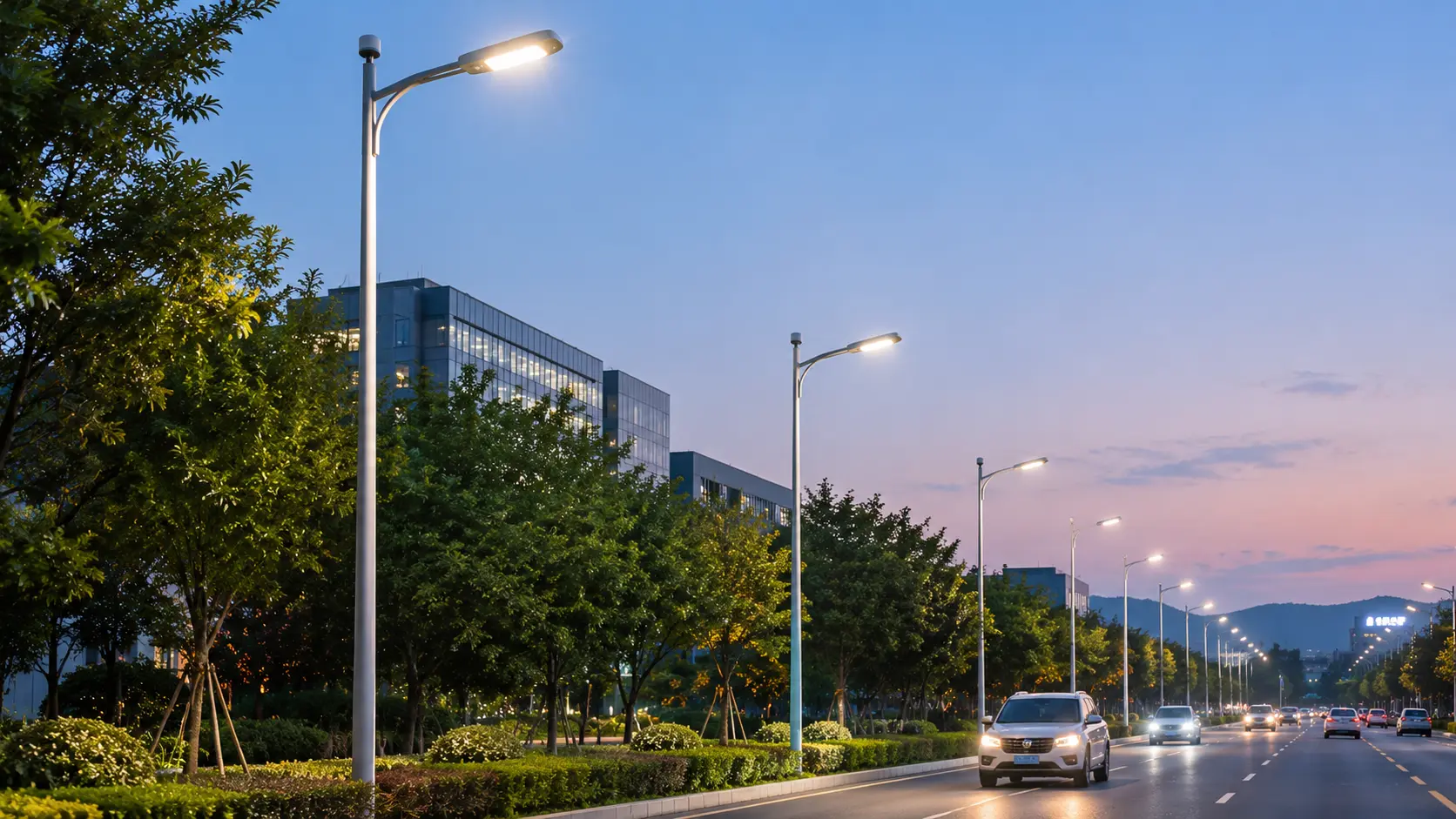
3. Configure and Verify Your smart LED street light Functions
Scheduled and Demand-Based Dimming
Dimming can also be programmed to decrease illumination at specific times. With the appropriate installation of sensors and controls, the lights will respond to their surroundings. The method of dimming must meet the criteria for the functioning of the road lights. Not all roads have to follow the same dimming schedule.
Consider this hypothetical example:
| Operating pattern | Nightly consumption |
| 100W for 12 hours | 1.20kWh |
| 100W for 6 hours, then 50W for 6 hours | 0.90kWh |
Under these assumptions, energy use falls by 25%. However, 50W represents assumed actual input power: a 50% dimming command does not necessarily halve consumption. Node and communication equipment consumption must also be included in the final assessment.
Remote Management and Fault Reporting
An integrated system can enable operators to schedule changes, monitor operational status, and receive alerts. Every such feature requires appropriate hardware and software:
• Remote switching and dimming: compatible nodes, communication range, and management platform.
• Energy consumption tracking: metering capability or supported driver information.
• Fault detection: appropriate detection and reporting capabilities.
Being DALI-capable does not mean being internet-capable, and wireless communications do not equal full fault-detection capability.
Defined Operation During Network Outages
Some smart LED street light systems continue operating according to their local schedules or switch to a predefined output level when communication fails, while others may respond differently. During a pilot project, it is essential to assess how the system handles network failures, power restoration, and reconnection. Predictable lighting operation should be maintained even when communication with the central control system is unavailable.
Conclusion: Plan and Verify Your smart LED street light Upgrade
An optimal solution to make the smart LED street light upgrade intelligent would be to apply the approach to the existing installation. Add a compatible controller when the light source is ready for this; add a new driver if other components are suitable for changes; and replace the whole fixture when the light is in poor condition or can no longer be modified. Before the upgrade, ensure effective communication, dimming, energy consumption, road illumination, and operation without a network connection.
0