目录
In bustling commercial centers, hospitals, and contemporary office settings, touchless sanitation devices have graduated from luxury items to industrial norms. Approaching a wall-mounted dispenser and gesturing one’s hand to obtain a clean piece of paper is made easy on the surface level. But behind the simple and smooth touchless experience lies an extremely precise coordination of mechanical devices. Studying how an Automatic Paper Dispenser receives and interprets touchless signals, determines the correct cut lengths, and performs paper-cutting operations within milliseconds helps not only appreciate advances in contemporary sensor technology but also provides practical guidelines for facility managers.
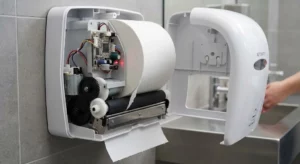
Key Hardware Components of Automatic Paper Dispensers
The inner structure of a commercial Automatic Paper Dispenser is composed of several key components. To understand the functioning process of an Automatic Paper Dispenser, it is necessary to take a look at what hardware it uses inside its ABS plastic housing.
Infrared Sensor Module
The primary detection trigger that sends out modulated infrared light (the frequency usually varies from 38 kHz to 40 kHz).
Microcontroller Unit (MCU): Acts as the main brain for the device. The MCU analyzes raw voltage pulses, detects fake triggers, and ensures time coordination between the motor and the blades.
DC Motor and Planetary Gearbox
Supplies the mechanical torque. This gearbox converts the motor’s RPM into manageable rotational torque that drives the movement of bulky paper rolls with ease.
Sheet Dispensing and Cutting Mechanism
Consists of rubber feed rollers along with a mechanical or motorized blade that helps drive the paper sheet forward and make cuts.
An example of a commercial sanitary product that features such a small drive mechanism is the CDwk CD-8808, with an overall design that retains high rigidity but still ensures system latency is much less than one-tenth of a second.
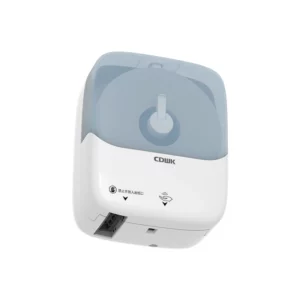
Detailed Working Procedure: Automatic Paper Dispenser
Once the user activates the device, its electronic and mechanical parts follow a tightly controlled feedback loop. The working procedure is as follows:
Step 1: Signal Emission and Reflection
The infrared transmitter continuously emits pulsed light beams downwards. When a person positions their hand under the device within the effective detection range (usually 5 cm to 15 cm), the infrared beam reflects toward the photo receiver.
Step 2: Photoelectric Signal Detection and Filtering
The photo receiver converts the reflected light signal into a very weak electrical signal. The digital filter embedded in the microcontroller rejects all sudden fluctuations in the intensity of the ambient light coming from overhead LED lights or sunlight.
Step 3: Logic Processing and Control Circuit Activation
The microcontroller, upon receiving the detection pulse, immediately activates the drive transistor controlling the operation of the motor to provide it with the required operating voltage, usually generated by a DC 6V battery pack or adapter.
Step 4: Motor Drive and Controlled Paper Feed
The drive motor begins to rotate, driving the rubber rollers and grabbing the moving paper web to feed it from the primary roll. The in-built rotary encoder makes sure the accuracy of feeding the paper sheets is within ±2 mm.
Step 5: Auto-Cutting and Stand-by Mode
Once the pre-set length arrives at the output chute, the system activates the internal steel cutter using a cam linkage to make the precise cut of the sheet. After this process, the whole system of the Automatic Paper Dispenser goes into sleep mode, instantly consuming only microamps of power.
Difference Between Motor Drive and Cutting Methods
There is a variety of cutting mechanisms used for Automatic Paper Dispensers in commercial washroom engineering, and the choice of configuration will determine future maintenance and the lifespan of batteries:
Integrated Mechanism Auto-Cut System
An auto-cut system uses the energy of the electric motor not only to move the feed rollers but also to move a spring-driven mechanical blade using an internal cam. When the paper reaches the preset length, the built-in mechanism automatically triggers the cutting blade. The main feature of this system is that it prevents users from pulling a sheet too forcefully, avoiding shock to the drive bushings.
Tear-off Systems with Sensing Motors
As an alternative, other dispensers use the motor to dispense only a certain length of paper out of the chute, with manual effort tearing the paper along the fixed serrated edge. Although this method reduces the electric load on the circuit board, it puts internal roller bearings under constant manual strain, making this option more appropriate for lower-to-average traffic situations.
For high-capacity public areas, choose an Automatic Paper Dispenser with mechanical cutting, which offers greater jam resistance when dispensing high-density or damp recycled paper rolls.
Performance Factors and Thresholds
Apart from basic sensing mechanisms, any commercial Automatic Paper Dispenser needs certain electrical and mechanical thresholds to function properly through thousands of cycles:
Sensor Response Time and Range
Precision optical controllers ensure sensor response times remain below 0.5 seconds and maintain a detection range of 5–15 cm, preventing duplicate triggers and unintended activation.
Dispensing Length
Counters limit the length of the dispensed paper to 200 mm and 300 mm, thus preventing any wasteful use of paper in the public toilet rooms.
Energy Management
The latest logic circuits ensure the standby current is less than 50 microamps, which makes it possible for the DC 6V battery system to perform up to 50,000 dispensing operations without maintenance.
Efficiency of Drive Torque
With the help of industrial gears, there is a minimum of 1.2 Nm torque output, making it possible for the rollers to unwind heavy 8-inch commercial paper rolls without any motor stalling.
Conclusion
In the end, the wall-mountable unit is a fine combination of optical sensors, microelectronics, and precise drive mechanisms. The choice of an Automatic Paper Dispenser that utilizes durable motor gearing and sophisticated logic boards significantly decreases the amount of paper consumed and raises the hygiene levels to a new level. As the technology of microcontrollers and optical sensors continues to develop, the future touchless dispensers will have even greater efficiency.
0