目录
A capping machine is widely used in industries such as food and beverage, cosmetics, pharmaceuticals, and chemicals to automatically apply and tighten caps on bottles or containers. Different types of capping systems are designed to handle various cap styles, container shapes, and production speeds. By understanding how these machines work, manufacturers can choose the right solution to improve efficiency and reduce manual labor in automated production lines.
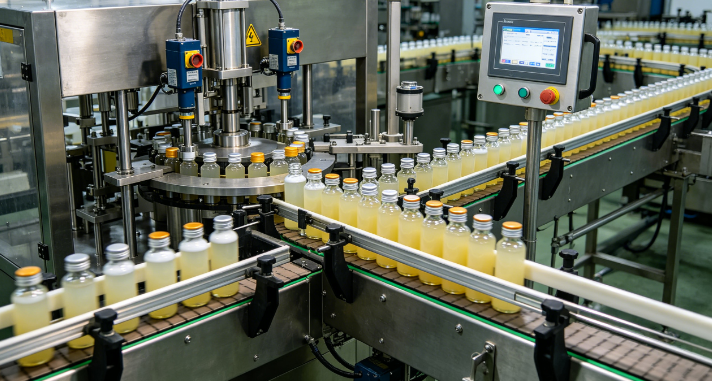
Working Principle of Automatic Capping Systems
Modern capping equipment operates through a coordinated mechanical and control system that ensures precise and consistent sealing:
- Cap feeding and sorting system
Caps are automatically arranged and delivered through a vibrating bowl or elevator system. This ensures a continuous and orderly supply of caps to the capping station without manual intervention. - Bottle positioning and alignment
Containers move along a conveyor belt and are accurately positioned under the capping head. Sensors detect bottle placement to ensure correct alignment before sealing begins. - Torque-controlled tightening process
The capping head applies controlled torque to tighten the cap securely. This prevents over-tightening or loosening, ensuring consistent sealing quality across all products.
How Screw Capping Machines Operate
Screw capping machines are one of the most commonly used systems in industrial packaging:
- Rotational tightening mechanism
The cap is placed on the bottle and then rotated by friction wheels or servo-driven heads until it reaches a preset torque level, ensuring a tight seal. - Adjustable speed and pressure control
Operators can adjust rotation speed and tightening pressure based on different bottle materials, such as glass or plastic, improving adaptability. - Wide application range
This type is suitable for beverage bottles, pharmaceutical containers, and cosmetic packaging, where consistent sealing strength is required.
Working Process of Press-On and Snap Capping Machines
Press-on and snap capping systems are designed for caps that do not require threading:
- Downward pressing mechanism
The cap is aligned above the container and pressed downward using pneumatic or mechanical force until it locks into place. - Quick application cycle
These systems are optimized for high-speed production lines, allowing rapid sealing of large quantities of containers in a short time. - Simple structural design
With fewer moving parts compared to screw systems, maintenance is easier, and operational downtime is reduced.
Features of High-Speed Rotary Capping Systems
Rotary capping machines are widely used in large-scale industrial production:
- Continuous multi-station operation
Bottles move through multiple rotating stations, including cap placement, tightening, and inspection, in a continuous cycle that improves efficiency. - Servo-driven precision control
Advanced servo motors ensure consistent torque application and synchronized movement, reducing sealing errors. - Integration with production lines
These systems are often connected with filling and labeling equipment to form a fully automated packaging line, improving overall productivity.
In many cases, advanced systems developed by capping machine manufacturers are designed to meet high-output requirements while maintaining sealing precision.
Advantages of Modern Capping Technology
Regardless of the type, modern capping systems offer several important benefits:
- Improved sealing consistency
Automated control ensures every container is sealed with uniform pressure and torque, reducing leakage risks. - Reduced labor dependency
Automation minimizes manual work, lowering operational costs and improving production efficiency. - High compatibility with different containers
Machines can be adjusted to handle various bottle sizes, cap types, and materials, making them suitable for multiple industries. - Enhanced production stability
Continuous operation and real-time monitoring reduce downtime and improve overall manufacturing reliability.
Conclusion
Different types of capping machines, including screw, press-on, and rotary systems, operate using specialized mechanisms to ensure secure and efficient container sealing. Each type is designed for specific production needs, offering unique advantages in speed, accuracy, and flexibility. As automation continues to advance, businesses increasingly rely on solutions provided by professional capping machine manufacturers to achieve stable, high-quality, and cost-effective packaging operations across various industries.
0