目录
An accessible pedestrian signal does not have to be installed at every crosswalk. Whether or not to install the accessible pedestrian signal depends on the type of crossing and the construction of the road.
The APS device serves as a means of providing non-visual crossing information to both blind and visually impaired pedestrians. APS can serve to assist pedestrians in identifying the push-button locations, WALK signals, and crossing directions. But the workings of a signalized and an unsignalized crosswalk vary.
1. What Functions Does an Accessible Pedestrian Signal Provide?
An accessible pedestrian signal is more than just adding sounds to the traffic lights. An accessible pedestrian signal conveys information about the pedestrian signals through sound or touch.
1.1 How Do Audible and Tactile Signals Help Pedestrians?
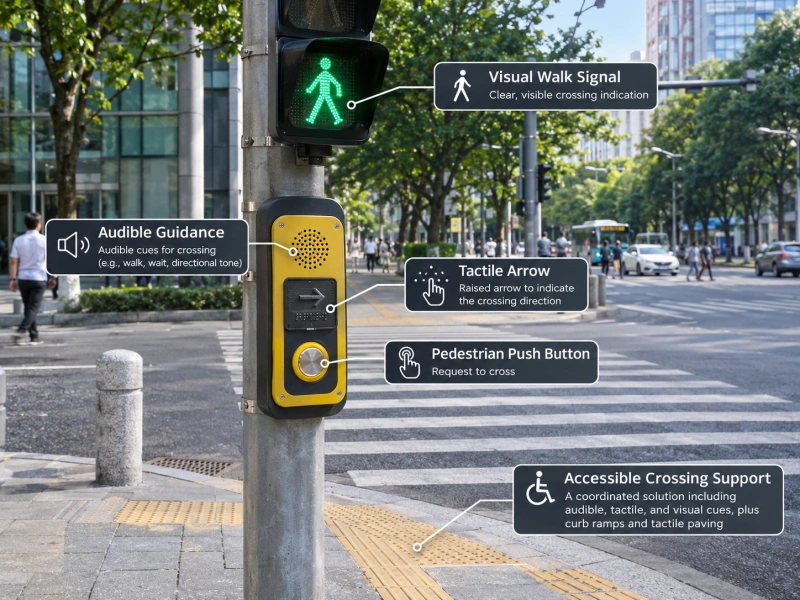
Four features are commonly associated with APS equipment.
1. Locator Tones
Locator tones assist pedestrians in locating pushbuttons. They are especially helpful in intersections that are very busy or in areas where pushbuttons may be hard to locate.
2. Audible WALK Signal
This is a signal that communicates the WALK phase to pedestrians. Pedestrians will not have to rely on the sound of vehicles to determine whether they can cross or not.
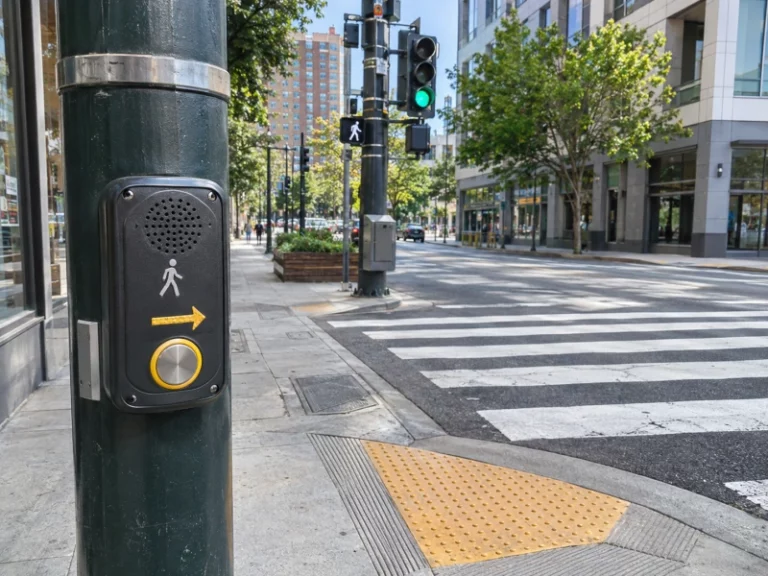
3. Tactile and Vibrotactile Indicators
Tactile arrows indicate direction to cross, whereas vibrotactile indicators transfer messages via touch. These indicators offer another way to get crossing messages.
4. Adaptive Volume Control
Adaptive volume control allows the audio message output to adjust depending on ambient noise. Audible signals may be loud in the presence of a lot of traffic and vice versa when there is less noise around.
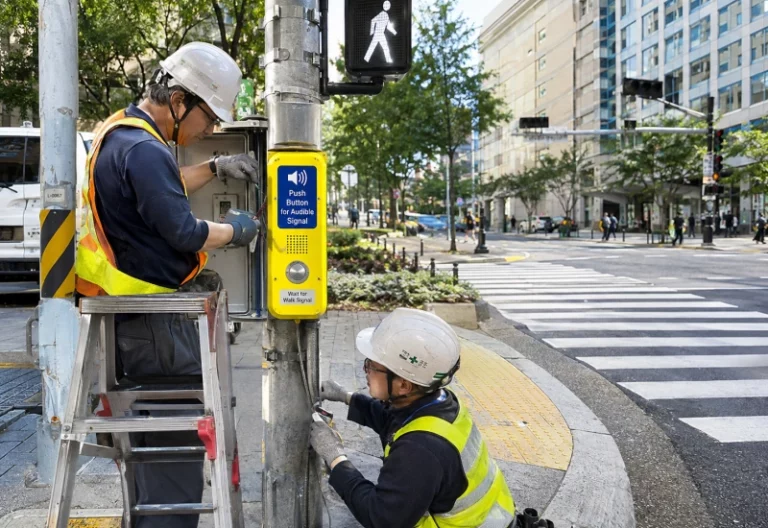
An example would be Sinowatcher’s Xentra Acoustic Guidance Unit, which is installed on poles and offers audible localization and crossing alerts configurable by the user. It allows adaptive volume control and is compatible with Xentra pedestrian push buttons. The acoustic guidance unit is just one part of the APS setup, and it’s not intended as a substitute for other features of such a system.
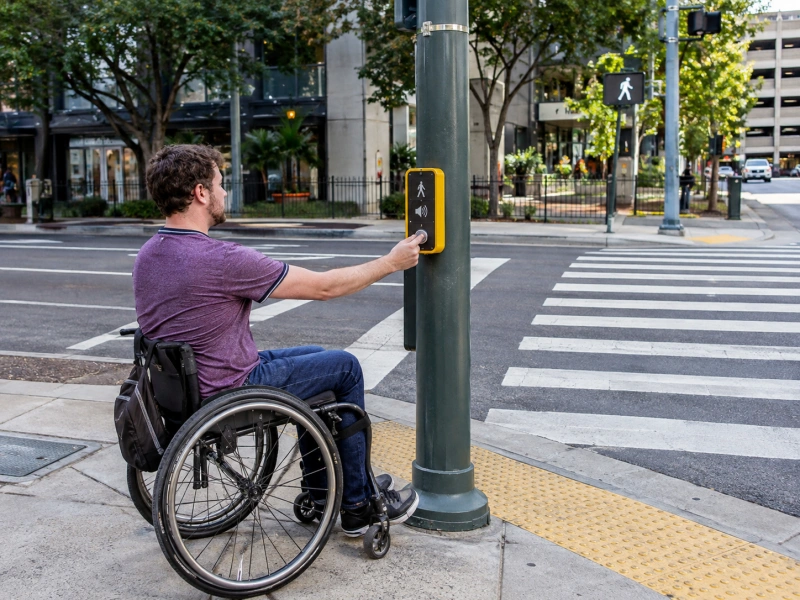
1.2 How Is an Accessible Pedestrian Signal Different From a Standard Pedestrian Signal?
Traditional pedestrian signals mostly rely on visual cues such as “WALK” and “DON’T WALK.” Those who cannot see such indicators may find it hard to receive the same information. APS devices provide nonvisual cues without altering the basic traffic regulations.
| Feature | Standard Pedestrian Signal | APS |
| Main communication | Visual symbols | Audible or tactile information |
| WALK identification | Visual display | Nonvisual indication |
| Button location | Primarily visual search | May include locator tones |
| Directional guidance | Visual and environmental cues | May include tactile arrows |
2. Why Are Accessible Pedestrian Signals Necessary?
Traffic sounds can provide useful clues, but they do not always indicate the pedestrian signal state accurately.
2.1 What Problems Can Pedestrians Face Without APS?
However, the movement of the parallel traffic stream may indicate the crossing point. Nevertheless, the movement of the traffic does not have any relation to the pedestrian’s WALK cycle.
There are several situations when the method does not work well:
• Several traffic light cycles: The movement of traffic can complicate its perception.
• Noise pollution: The presence of buses, trucks, and other vehicles can block environmental sounds.
• Atypical intersection: Angular streets and extra crosswalks may confuse the direction of movement.
• The wrong placement of the button: People can have difficulty finding the crosswalk signalizer.
2.2 How Can APS Support Independent Crossing?
APS is capable of reducing the requirement for assistance in crossing signalized intersections.
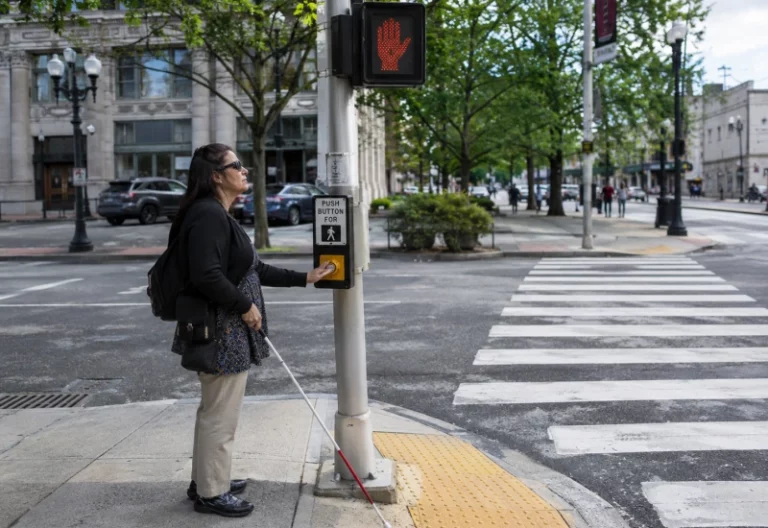
For instance, in a case where there are many crossing points in a junction, the pedestrian will have to locate the right pushbutton and the appropriate WALK indication. The locator tones will assist in locating the button, whereas the tactile arrows will give directional information, and the audible/vibrotactile indications will indicate the status of the pedestrian signals. APS is not able to eliminate all traffic dangers. The pedestrians will still need to be aware of their surroundings.
3. When Is an Accessible Pedestrian Signal Required at a Crosswalk?
The choice of installation is based on crossing design, regulations, and the extent of construction or modification activity. Road width or traffic volume does not determine whether an APS is legally required.
3.1 Do Signalized and Unsignalized Crosswalks Have Different Requirements?
A signalized crosswalk employs pedestrian signals that operate from the traffic signal controller. An APS may transmit such pedestrian signals using non-visual elements. An unsignalized crosswalk does not have a pedestrian WALK phase; therefore, signalized APS may not be appropriate.
| Crossing Type | Typical Equipment | Main Accessibility Concern |
| Signalized | Pedestrian lights, buttons, controllers | Nonvisual WALK information |
| Unsignalized | Markings, signs, warning devices | Crossing identification and traffic conditions |
| Complex Signalized | Multiple signals, turning lanes | Directional clarity and signal recognition |
The requirements for APS in the U.S. include the Americans with Disabilities Act (ADA), the Manual on Uniform Traffic Control Devices (MUTCD), and other related accessibility requirements.
These requirements cannot be simply generalized into an absolute rule that applies to all marked crosswalks. The relevant standards, location, and project scope need to be taken into account.
3.2 Which Intersection Conditions Make APS More Important?
Multiple-lane turns, long crossings, or complicated phasing may call for a more detailed accessibility assessment.
Take the example of a crosswalk, which is 18 meters long. Given the normal walking speed of 1.07 meters per second (3.5 feet per second), the basic time will be: 18 ÷ 1.07 = 16.8 seconds
This calculation does not represent the actual walk interval time or pedestrian clearance interval time requirements. The signal timing should comply with standard requirements. Municipalities will have to factor in the pedestrians’ complaints regarding their inability to find the button, hear the signals, or see the correct direction for crossing. This data helps identify accessibility issues but doesn’t generate equal legal obligations on all intersection points by itself.
There are three major considerations for installing APS:
• Crossing type: Is there a need to install pedestrian signals requiring some means of nonvisual communication?
• Regulations applying: What regulations apply to the location/project?
• Accessibility considerations: Are pedestrians able to locate the crossing, know the crossing’s orientation, and receive reliable signal information?
Conclusion
Accessible Pedestrian Signals are not subject to the same installation requirements for every crosswalk. Several factors affect whether APS are required at a particular intersection, including traffic control measures, legal considerations, intersection design, and pedestrian requirements. When APS are required, locator tones, audible WALK signals, tactile elements, and appropriate volume control may assist pedestrians in accessing crossing information.
0