
目录
Hand fans have existed for centuries and have been discovered throughout all cultures as functional devices and ornaments. They cool us down in warm weather but also carry symbolic meaning, style, and imagination. In the past, different areas built up their own particular fan customs.
Of these, Spanish hand held fans are especially recognizable through their look and culture. In order to understand their place today, it is necessary to study the Spanish styles and overall traditional hand fans in relation to others that can be found from other cultures or time periods.
Origins and Cultural Context
- Traditional design hand fans have been used for millennia in Asia, Europe, and Africa. They tended to be made of feathers, palm leaves, or paper, and they served an everyday purpose: to circulate air in warm weather. Over time, they also became associated with rituals, ceremonies, or displays of wealth.
- Spanish hand held fans, however, have a specific cultural heritage. Introduced to Spain through foreign trade, they came to represent everyday living and social relations. Compared to more generally applicable traditional fans, they came to be inextricably linked to Spanish communication, courtship, and dance.
- Therefore, in social gatherings, for example, Spanish fans were used discreetly in order to send messages using the body language, something that was not often displayed by other societies. This kind of integration distinguishes them from fans that were purely functional or ceremonial in nature.
Design Differences
In a comparison of Spanish hand held fans to other traditional fans, design is perhaps one of the most clear points of contrast. Fans from other regions traditionally might be rigid or cylindrical, sometimes made entirely of feathers or palm fronds. Their construction tended to prioritize ease or simplicity.
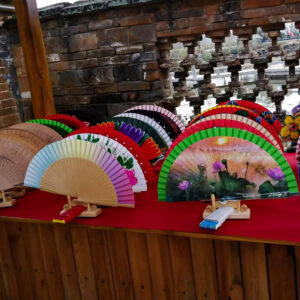
Spanish fans, on the other hand, are usually folding fans, made of a wooden or bone frame with intricately decorated paper or fabric panels.
- The folding aspect is the key to it all: it makes the fan light enough to carry, elegant enough to desire, and easy to open and close with fanfare.
- Spanish fan ornamentation is also bright and artistic, often featuring lace, painted flowers, or geometric patterns. These aren’t merely pleasing to the eye but also reflect Spanish identity.
Function and Use
Early hand fans were more often used as tools to provide airflow, although in some parts of the world they also had ceremonial meaning. Spanish handheld fans, however, evolved beyond such purpose.
- They became stage props for flamenco dance performance, wherein rhythm and feeling are accentuated by opening and closing action.
- They were also employed as a silent language communications system, wherein different gestures would signify different messages among individuals.
This multi-purpose use distinguishes Spanish fans. While traditional fans can be waved over royal courts or carried by individuals who reside in hot climates, Spanish fans made their way into everyday use and stage use. Their application to story telling and dancing shows how the use and culture can blend into something.
Materials and Craftsmanship
Another area of difference lies in craftsmanship. Fans of yesteryear were typically simple, with whatever was available locally being utilized as material. The materials could be bamboo, palm leaves, or feathers. The fans were definitely beautifully made, but they tended to symbolize mere practicality.
Spanish hand fans, in contrast, are renowned for their ornate craftsmanship. Some are carved from wood, lace, or hand-painted characters.
- Others even feature precious metals or inlays in ornamentation.
- This emphasis on craftsmanship means Spanish fans are collected as much for beauty as use.
- Spanish fans may be heirlooms, presents, or decorations, whereas many traditional fans are valued only because of history or culture.
Symbolism and Identity
Traditional hand fans are of symbolic value according to culture. In certain regions, for example, they represented religion or status. Spanish hand held fans, nevertheless, hold a unique identity that is strongly related to Spanish culture in general.
- They stand for elegance, expression, and artistry. They are not just tools; they are symbols of lifestyle, projected in fashion, festivities, and dance.
This cultural legacy lives on to the present day. Tourists also purchase Spanish fans as souvenirs, not merely because they are useful but also because they represent a connection to Spanish culture. Fans from other cultures could be unfamiliar outside of that culture to the same extent.
Current Popularity
Today, there exist both types of fans, but their usage differs. The traditional hand fans are normally stored in museums, used in cultural performances, or replicated to be employed in festivals. They remind us of ancient traditions but no longer work often in life.
Spanish hand held fans, on the other hand, are still popular in both practical and aesthetic uses.
- They are available in markets, used during weddings or summer celebrations, and continue to be used in flamenco dance.
- The fact that they can integrate into modern life makes them different from other fan cultures that may have reached symbolic or ceremonial use.
Conclusion
Whereas traditional hand fans in other parts of the world share a unifying history of symbolism and purpose, Spanish hand held fans are distinct in their blending of utility, artwork, and cultural heritage.
From their folding design and elaborate craftsmanship to their application in dance and in communication, they are more than a tool to ventilate. They are a lifestyle and a heritage that continues to endure today.
The difference is not simply one of how they are made but also of how they are used and remembered. Traditional fans continue to hold meaning as cultural artifacts, and Spanish fans continue to exist as continuing performances of identity, blending past and present meaning.
0