目录
What is a Fiber Faceplate?
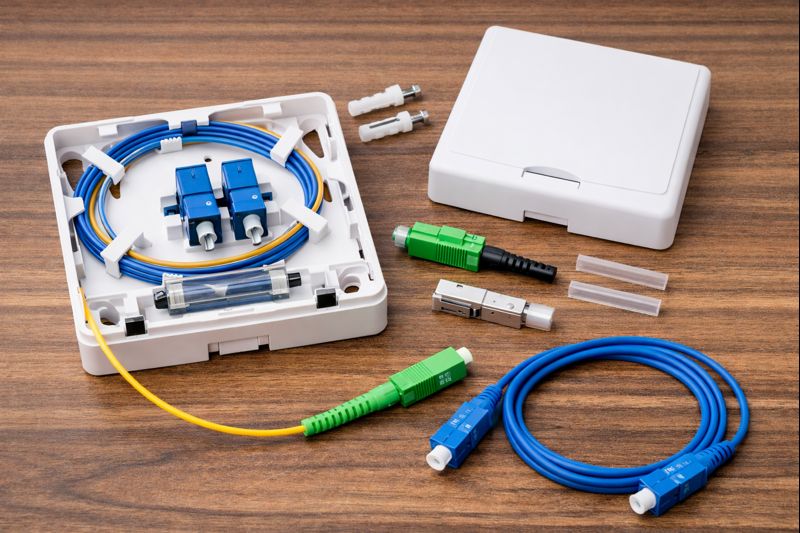
A fiber faceplate, also known as a fiber panel or fiber outlet, is a critical terminal device used in FTTH (Fiber to the Home) indoor cabling systems. It provides 8 or 16 channels of fiber optic signal interfaces, connecting incoming fiber cables to fiber patch cords. A fiber faceplate not only serves as the physical endpoint for fiber connections but also protects fiber splices, organized storage, and cable management.
The materials and structural design of a fiber faceplate directly affect its mechanical strength, durability, and the quality of fiber signal transmission. In practice, a Fiber Faceplate integrates fiber splicing, termination storage, and cable connection functions into a compact, sturdy, and easy-to-install solution for indoor networks.
Main Materials of a Fiber Faceplate
1. ABS Plastic Housing
- Material Characteristics: ABS (Acrylonitrile Butadiene Styrene) is a high-strength engineering plastic with excellent impact resistance and aging durability. Its smooth surface is easy to process, dimensionally stable at room temperature, and resistant to deformation. ABS also has good heat resistance, making it suitable for the temperature variations commonly found in indoor environments.
Functional Role:
- Protecting fiber splices: The ABS housing effectively shields the internal fiber splices and patch cord connections from external impacts, pressure, and minor drops.
- Enhancing mechanical strength: The rigid structure supports fiber adapters and internal bend management trays, maintaining stability during transport, installation, or maintenance.
- Supporting overall assembly and facilitating installation: ABS is lightweight yet strong, allowing easy installation while securely holding fiber and adapter components in place over long-term use.
2. Fiber Adapter Materials
The internal fiber adapters are key components for signal transmission, typically made from:
- Ceramic Sleeves: Ceramics offer high dimensional stability and wear resistance, ensuring precise alignment of fiber end faces, minimizing optical signal loss. Ceramic sleeves are heat-resistant and corrosion-resistant, guaranteeing long-term, reliable fiber connections.
- Engineering Plastic or Metal Housings: These materials fix the adapters in place and improve durability. Plastic provides lightweight flexibility, while metal parts enhance impact resistance. The housing also prevents adapters from loosening during repeated use, ensuring stable optical signal transmission.
The combination of these materials ensures that the Fiber Faceplate is compatible with SC, FC, and LC adapters and maintains high precision and reliability during multiple insertions and removals.
3. Fiber Storage and Bend Management Materials
Fiber faceplates include internal bend management structures, mainly made of ABS or polycarbonate (PC) plastics:
- Heat and wear resistance: These materials can withstand the friction and pressure generated during fiber bending, stretching, and securing. While remaining stable in indoor high-temperature environments.
- Low-friction surface treatment: Smooth surfaces reduce fiber abrasion and minimize micro-loss during bending or coiling.
- Controlled fiber bend radius: Properly designed bend trays ensure that fiber cables maintain the recommended bend radius, preventing excessive bending that could increase optical loss or cause fiber breakage, maintaining signal quality and reliability.
This material selection and structural design are key to ensuring the long-term safe use of fiber faceplates.
4. Splicing and Connection Auxiliary Materials
Fiber faceplates support multiple fiber termination methods, requiring auxiliary materials such as:
- Heat Shrink Sleeves: Made from heat-shrinkable plastics, these sleeves secure spliced fiber ends, ensuring alignment and protecting against external forces. When heated, they shrink to tightly wrap the fiber, enhancing mechanical strength and environmental resistance.
- Mechanical Splice Materials: Typically made of engineering plastics and metal, these components ensure precise fiber alignment and reliable splicing. Mechanical splices are reusable, improving construction efficiency.
- Quick Installation Connector Materials: Combining plastics with metal spring clips, these connectors allow tool-free, fast fiber installation, suitable for rapid deployment or on-site maintenance.
These materials enable the Fiber Faceplate to accommodate different installation methods. Including patch cord + mechanical splice + adapter, patch cord + fusion sleeve + adapter, and quick-install connectors + adapter, ensuring stable and reliable fiber connections.
Protective and Reliability Materials
To ensure safety and durability during daily use, Fiber Faceplates also incorporate materials for protection:
- Dust-proof Cover (ABS Plastic): The cover uses a snap-fit design for easy installation and removal, preventing dust and debris from entering the fiber area, which reduces optical loss and connector contamination.
- IP45 Protection Level: The housing and internal components meet IP45 protection standards, effectively preventing dust ingress and light water splashes from affecting fiber performance.
- Internal Support Materials: Durable plastics or reinforced engineering materials keep fibers in place during transport, installation, and use, maintaining end-face stability and signal quality.
These material combinations ensure that the Fiber Faceplate provides stable and reliable fiber connections in a variety of indoor environments.
Conclusion
The main materials used in a fiber faceplate include an ABS plastic housing, ceramic or engineering plastic adapters. Plastic bend management trays, internal supports, and heat shrink sleeves or quick-install connector materials. The ABS housing provides strength and protection while remaining easy to install. Ceramic or plastic adapters ensure precise fiber alignment, and bend trays with supports control the fiber radius to reduce signal loss. Heat-shrink sleeves and quick-install connectors keep fiber connections stable. Careful material selection enhances durability and ensures reliable optical performance in FTTH, FTTO, and FTTD applications.
0