目录
When people are crossing a busy road junction, most of them use the traffic lights as their guide. But visually impaired pedestrians cannot use the visual aids provided by the traffic lights. In a complicated traffic junction, noise from traffic does not necessarily mean that the traffic light is giving a signal for the pedestrian to cross the road. There are pedestrian crossings that provide auditory aids and, in some instances, tactile guides for visually impaired pedestrians to know the traffic.
But just having the auditory aids does not automatically make the road safe for pedestrians.
1. How Does an Audible Pedestrian Crossing Work for Blind Pedestrians?
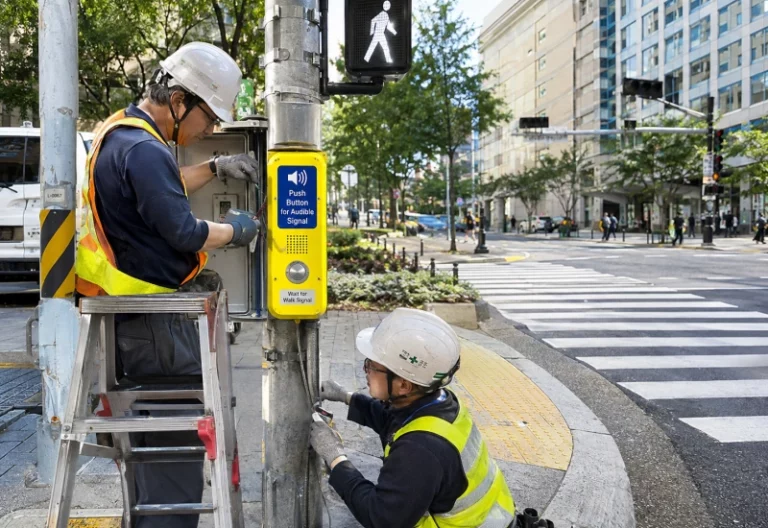
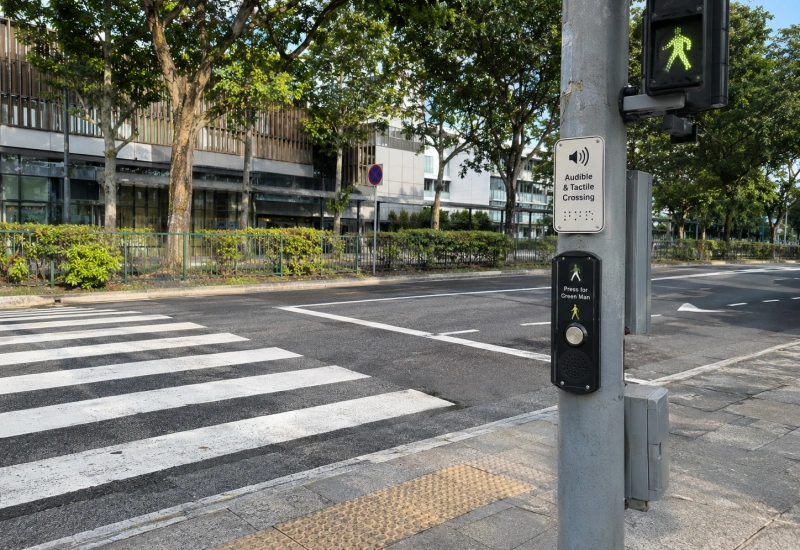
The audible pedestrian crossing is where some of the visual information from the traffic lights is converted into sounds so that blind pedestrians can tell that the WALK signal is on. In the United States, such components are usually part of Accessible Pedestrian Signals (APS).
1.1 What Is an Audible Pedestrian Crossing?
An audible pedestrian crossing is usually associated with the traffic light controller and generates audio or verbal announcements during certain phases of the traffic light cycle.
Three basic operations take place:
• Equipment location: The locating tone helps pedestrians locate the pedestrian push button.
• Pedestrian request for crossing: If there is any need to cross, pressing the button creates a pedestrian request for the traffic light controller.
• Signal information reception: When the corresponding WALK phase starts, there is an audio indication generated.
Locator tones and WALK signals are meant for different functions. The former is intended to help the pedestrians locate the device, while the latter indicates the state of the pedestrian signal. What is more important is that the audible crossing signal is not aware of whether all vehicles have stopped or not.
1.2 What Features Make Audible Pedestrian Crossings More Accessible?
Accessible crossing systems often combine several features instead of relying on sound alone.
| Feature | How It Works | Main Purpose |
| Locator Tone | Produces a sound near the push button | Helps pedestrians locate the button |
| Audible WALK Signal | Plays a tone or spoken message during WALK | Identifies the crossing phase |
| Tactile Arrow | Uses a raised arrow to indicate direction | Identifies the associated crosswalk |
| Vibrotactile Indicator | Vibrates during the WALK phase | Provides additional tactile information |
The functions of audible localization and volume control are very helpful when it comes to noisy urban intersections. The sound should be intelligible without being unnecessarily loud.
For instance, the Xentra Acoustic Guidance Unit for Accessible Pedestrian Signal Systems by Sinowatcher is a pole-mounted unit providing audible localization and crossing warning. It features adaptive volume control according to the environment and is compatible with Xentra pedestrian push buttons. This equipment can be installed at urban crosswalks and intersections requiring clear audible guidance. Tactile arrows and vibratory indicators are other means of information access. These options are especially important for those pedestrians who cannot use their hearing fully.
2. How does an audible pedestrian crossing help in safety and independence?
The audible pedestrian crossing allows the blind pedestrian to get information that might have been gathered by using vision. It may enable the pedestrian to move independently and be less dependent on the help of others. The efficiency of an audible crossing depends upon the geometry of the crossing, noise from traffic, signaling time, etc.
2.1 What Challenges Do Blind Pedestrians Face at Intersections?
The difficulties that can be faced by visually impaired people when they use a crosswalk include:
• Inaccessible traffic lights: If there is no audible signal indicating the WALK light, it will not be easy to know when the light comes on.
• Complicated street layout: The lanes, islands, and complicated layout of the intersection will make it hard.
• Noise from the environment: Sounds from construction work, from the trucks, and from the heavy traffic will be distracting to visually impaired individuals.
• Differences in the equipment: Location, sound, and conditions of the equipment at different intersections.
Audible pedestrian crossing will help to solve some of these issues, but orientation and mobility training, canes, and guide dogs will still be required.
2.2 How Do Blind Pedestrians Use Audible Crossing Signals in Practice?
There are many points at which the pedestrian at the intersection can use APS at different stages.
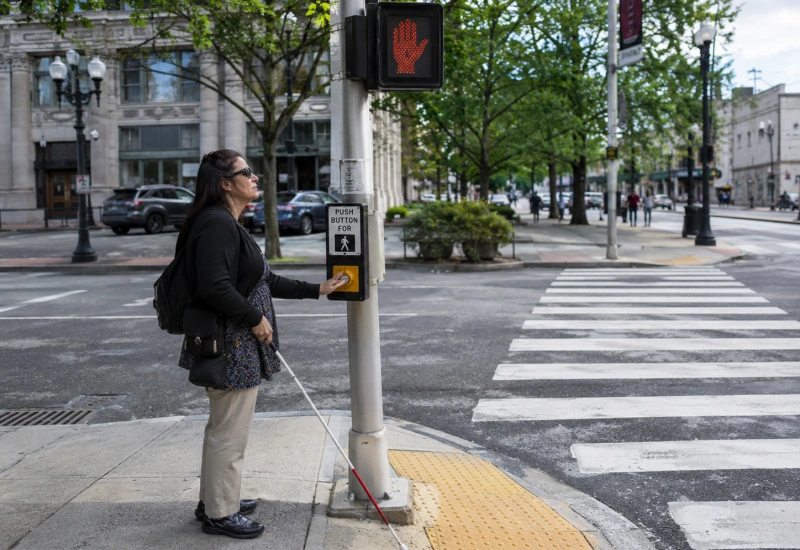
Stage 1: Locating the Push Button. At this stage, the pedestrian locates the push button for crossing the road using locator tones and cues in the environment.
Stage 2: Direction Identification. This involves identifying the directional arrow indicating the location of the crosswalk related to the push button.
Stage 3: Activation of Signal. At this stage, it is required that the pedestrian presses the button to activate the signal.
Stage 4: Identification of the WALK Signal. This includes the pedestrian receiving an auditory or vibration signal of the current pedestrian signal.
Stage 5: Crossing the Street. The pedestrian applies orientation and mobility as well as traffic information.
The above is just a sample of how APS operates, and it is not a guide on crossing the street.
Why does signal timing matter?
Overall, in the USA, the Manual on Uniform Traffic Control Devices (MUTCD) uses 3.5 feet per second, or 1.07 meters per second, for the pedestrian clearance interval calculation.
Therefore, if the distance equals 14 meters, then: 14 ÷ 1.07 ≈ 13.1 seconds
It will take 13.1 seconds to cover this distance.
As you see, this simple formula takes no account of the signal cycle and does not estimate the WALK signal duration. The objective of this example is to demonstrate the need for audio aids to complement the correct pedestrian signal timing. The audio aids cannot compensate for bad crossing conditions in any manner whatsoever. The intensity of the sounds produced is influenced by ambient noise. The modern audio crossing signals adjust their sound intensity according to ambient noise.
Nevertheless, enhanced sound intensity is not always a solution to the issue. The sound quality, directional sound, and ambient environment have to be considered too. The speakers, push buttons, and wiring of the signals should be periodically tested.
Conclusion
Audible Pedestrian Crossings help visually impaired pedestrians gain access to traffic signals via locating tones, WALK signals, as well as other touch aids. Such systems may help make a difference in terms of accessibility and independent mobility, although they do not solve all traffic safety issues. Correct button placement, directional information, adequate signalization, and proper maintenance play crucial roles. Audible Pedestrian Crossing is not only about making sounds, but also about helping pedestrians understand traffic signs they cannot see.
0