目录
It may also be possible for an individual to gain muscle at home without having a well-equipped gym because there are several bodyweight exercises, dumbbells, resistance bands, and a pull-up bar to help with the process. It is entirely based on picking the appropriate exercises, applying the progressive overload principle, and being consistent.
The workout routine performed at home should include exercise movements that will work on all major muscles. For instance, exercises like push-ups, pull-ups, squats, lunges, and glute bridges. Performing all the above exercises in control and with the required intensity, half an hour to forty-five minutes is enough time for beginners. It is not about doing many repetitions but adding intensity as well to the exercises.
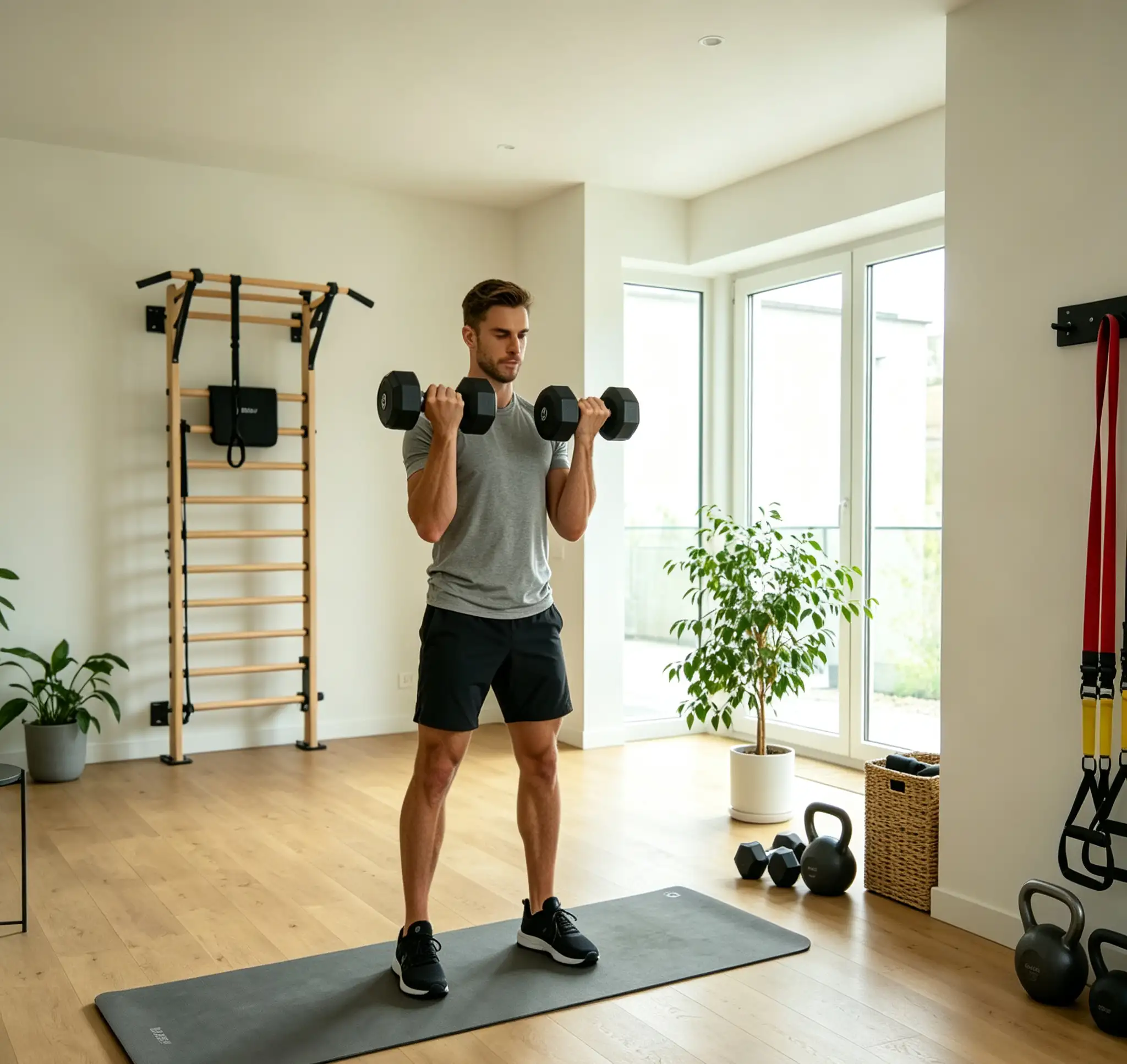
What Are the Best Exercises for Building Muscle at Home?
A good workout routine at home must include exercise movements that will work the chest, back, shoulders, arms, legs, and glutes muscles. Also, performing exercises that involve the upper body and lower body makes the programming much simpler without the need for much equipment.
Push-Ups for Chest, Shoulders, and Triceps
One of the easiest exercises to perform at home for strengthening the upper body is performing push-ups. Push-ups work the pectoral muscles, triceps, and anterior deltoid muscles, while the core muscles act as stabilizers during the exercise. The use of body weight as resistance in this case allows the exercise to be done in accordance with one’s strength.
The exercise starts with an incline push-up, where a stable elevated surface serves as support. Once regular push-ups become easy, it will be possible to do other variations of this exercise, like close-grip or decline push-ups. It is useful to start with 2-4 sets of 8-15 reps.
Pull-Ups for Back and Biceps
The pull-up is one of the best pulling exercises for the upper body and works mostly on the back muscles and biceps. Unlike push-ups, pull-ups need some extra equipment such as a pull-up bar.
If pull-ups are hard to perform at first, there are assisted versions of the exercise that can be performed. Gradually increasing the number of repetitions to create a progressive overload can be done by performing 2–4 sets of 4–10 reps.
Squats for Building Stronger Legs
Some of the muscle groups that can be strengthened through squats are the quadriceps, the glutes, and the hamstrings. The core also takes part in squats since they help improve stability. Squats are recommended when training at home because they do not require any or few pieces of equipment. For beginners, 3 sets of 10-15 reps can be performed with bodyweight squats.
Once bodyweight squats become easy, the next step would be trying goblet squats, backpack squats, or even increasing the resistance. Slowing down the downward motion during squats is also one of the ways to increase their intensity without having to spend much extra time on workouts.
Lunges for Single-Leg Strength
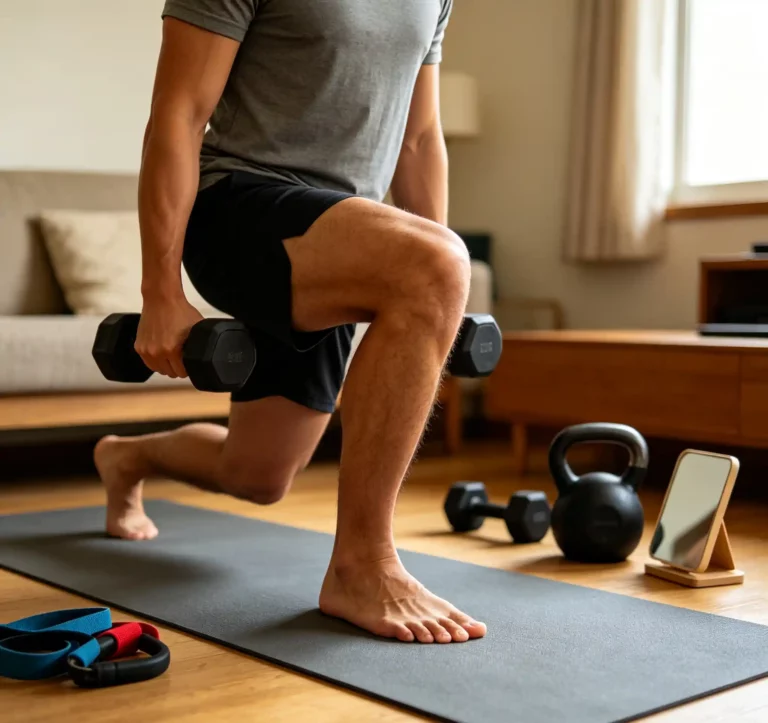
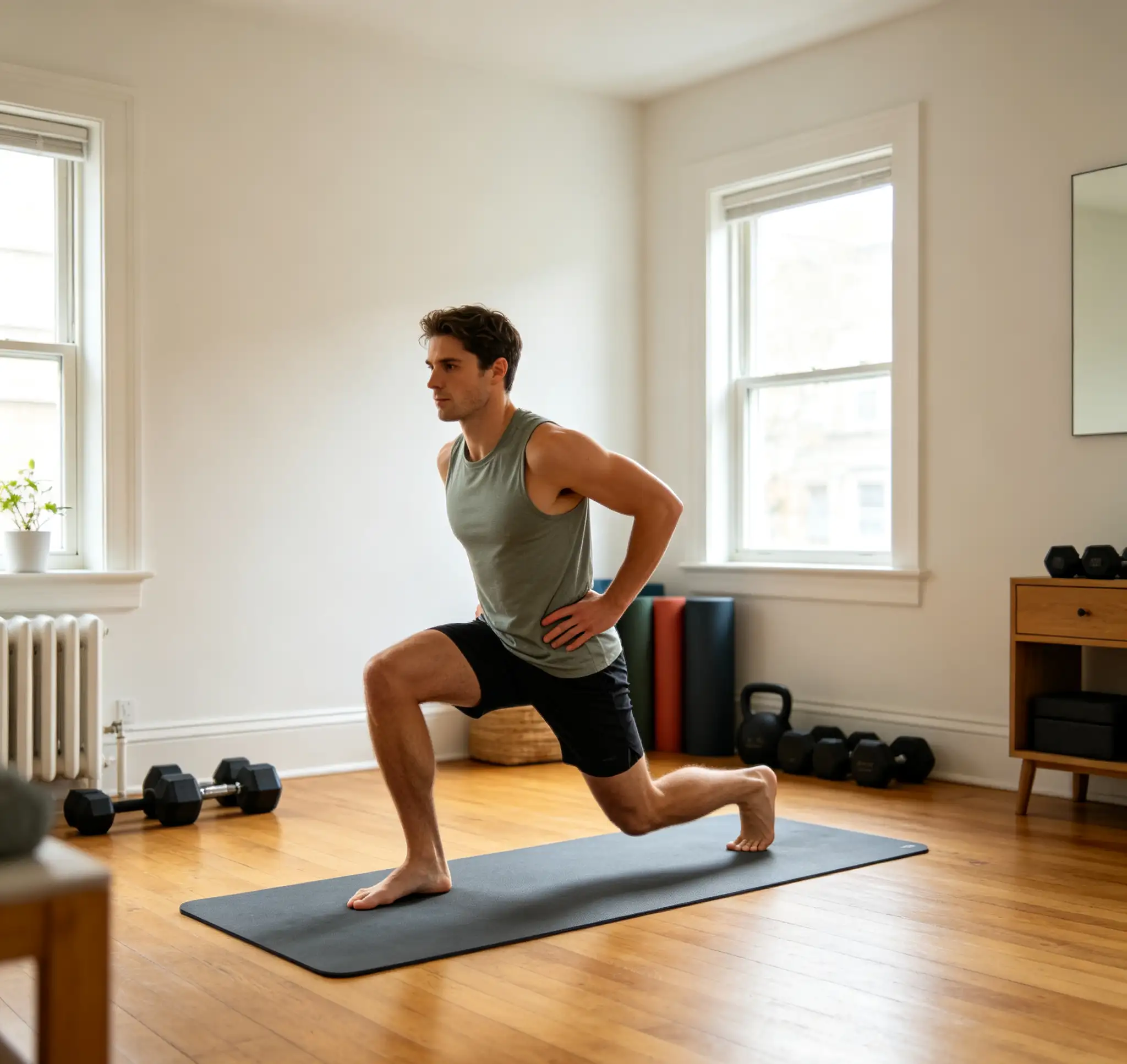
Lunges are examples of exercises on one leg and are responsible for strengthening the muscles of the lower part of the body, as well as improving the body’s balance and coordination. In other words, when doing the lunge exercise, the quadriceps, glutes, hips, and muscles of the core region become active. For a beginner, the reverse lunge would be an ideal choice as it is more controlled than the normal lunge exercise. Perform 2-3 sets of 8-12 repetitions per leg without resistance.
Control is key in performing the exercise as it ensures equal engagement of both sides of the body. One should avoid the dominance of the strong side, which affects performance, and should remain stable throughout the exercise. As one gets stronger, he/she can introduce dumbbells or increase repetitions.
Glute Bridges for the Glutes and Hamstrings
Glute Bridges primarily focus on glutes and simultaneously activate hamstrings and core muscles. These are perfect exercises for working out at home since they do not require much room or equipment. Perform the glute bridges lying down flat on your back with legs bent and feet placed firmly on the ground, and raise the hips without moving the torso and engaging the glutes.
At first, 2-4 sets of 10-20 reps would be ideal, bringing down the hips in control after each rep. As the bodyweight Glute Bridge becomes easier, try adding some resistance across the hips.
How Should You Structure a Home Muscle-Building Workout?
Exercising the right exercises is only one component of building muscles. How these exercises are arranged influences how much training stimulus is delivered to each muscle group and how much time there is for recovery. Therefore, an easy full-body exercise routine will require an upper-body pushing exercise, an upper-body pulling exercise, a lower-body exercise, and an exercise for the glutes. Thus, the work of many muscle groups is provided by just several exercises.
How Many Sets and Repetitions Should You Do?
How many sets and repetitions are needed varies based on training experience and exercise complexity, as well as the resistance that is used. Typically, 2–4 sets per exercise are sufficient for beginners. One possible structure would look as follows:
| Exercise | Starting Sets | Repetitions |
| Push-ups | 3 | 8–15 |
| Pull-ups | 3 | 4–10 |
| Squats | 3 | 10–15 |
| Lunges | 2–3 | 8–12 per leg |
| Glute bridges | 3 | 10–20 |
These numbers are considered an estimate and not a requirement. This means that as the difficulty of exercises increases, it makes sense to increase weight or repetitions or even make movements more difficult.
How Often Should You Train Each Muscle Group?
The program of exercises for beginners implies 2 or 3 strength training sessions per week, which is enough time for recovering from intensive workouts. It must contain exercises which will work several muscle groups at once, and it is possible using full-body exercises.
For example, it can be Monday, Wednesday, and Friday for training. With increasing experience and strength, you can adjust your schedule according to your goals and recovery needs. There is no need to train the same muscles intensively every day, as they require enough time to recover.
How Much Rest Do You Need Between Workouts?
The recovery period is a vital step in the muscle-building process. The recovery period of about 48 hours between workouts of the same muscles might be adequate for beginners. Attention should also be paid to the resting period between sets that usually varies from 1 to 3 minutes in strength training exercises. Other aspects like sleep, diet, and hydration can also affect the recovery process. In case of noticing performance decline and muscle soreness, the intensity of the workouts should be decreased.
Conclusion
Home exercises that work well to build muscles need not necessarily be those that are complex in nature. Home workouts such as push-ups, pull-ups, squats, lunges, and glute bridges can be quite effective to build up the muscles since they train the body’s major muscle groups without requiring too much equipment. To ensure continuous progress, it is recommended to start with light resistance, practice good form, and gradually increase the level of difficulty.
0