目录
Among the most popular core workouts are crunches and planks. Both exercises do not require special equipment and can be performed at home or at the gym. However, both have different effects on the core.
On the one hand, crunches are dynamic exercises involving the contraction of the abdominal muscles as a result of flexing the spine; on the other hand, planks are static exercises aimed at creating muscle tension without moving the body.
Nevertheless, which exercise to choose? Everything depends on the goals you set – while crunches are effective for strengthening the abdominal muscles, planks are useful for stabilizing the trunk.
1. Crunches vs. Planks: What Is the Difference?
Although both exercises involve the abdominal muscles, their movement patterns and training purposes are different.
| Comparison | Crunches | Planks |
| Exercise type | Dynamic | Isometric |
| Main function | Spinal flexion | Trunk stabilization |
| Primary focus | Rectus abdominis | Core stabilizers |
| Shoulder involvement | Low | Higher |
| Glute involvement | Low | Higher |
| Usually measured by | Repetitions | Time |
| Beginner target | 8–15 reps | 15–30 seconds |
Crunches: Focus on Dynamic Abdominal Contraction
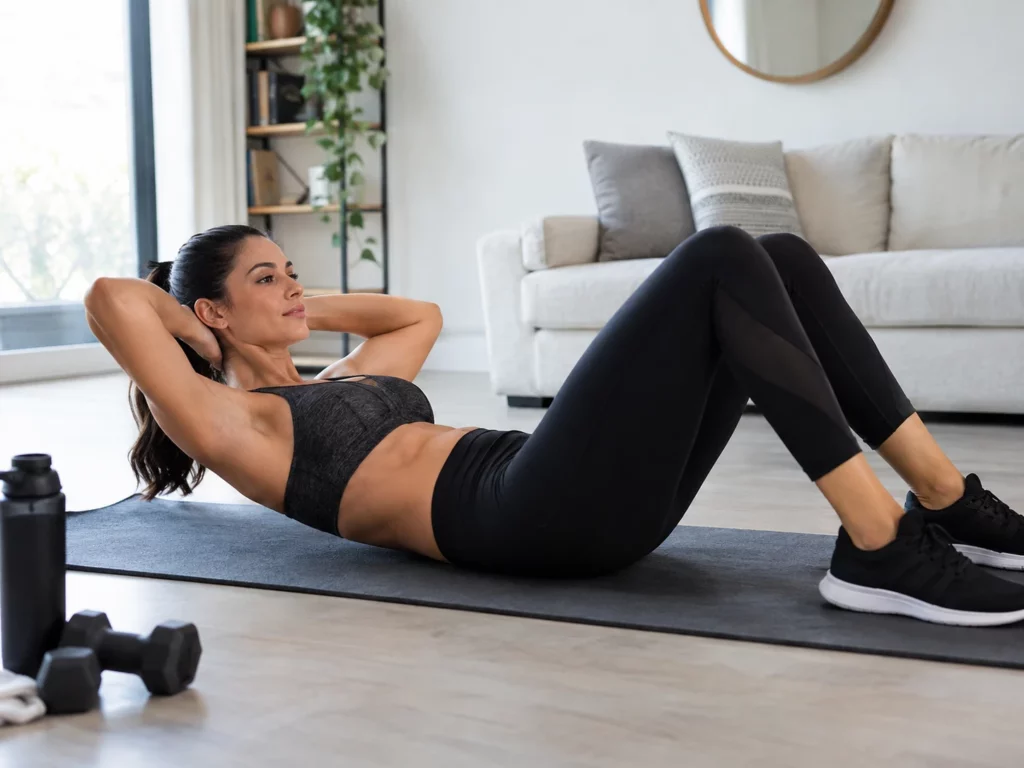
A regular crunch will have you lying down flat on your back with your knees bent. Tighten your abdominal muscles and raise your shoulder blades off the floor by a slight distance prior to lowering yourself in a controlled manner.
The primary intention here is to target the rectus abdominis muscle through spinal flexion.
There is no need for you to raise your entire upper body. This changes the exercise into a sit-up and places additional stress on the hip flexors.
For starters, you can begin with:
2–3 sets of 8–15 reps
Remember to control your movement rather than aiming for higher rep numbers. If you find yourself able to do 15 reps easily, you might want to think about slowing down your descent, introducing proper resistance, or moving onto a different variation.
Planks: Focus on Core Stability
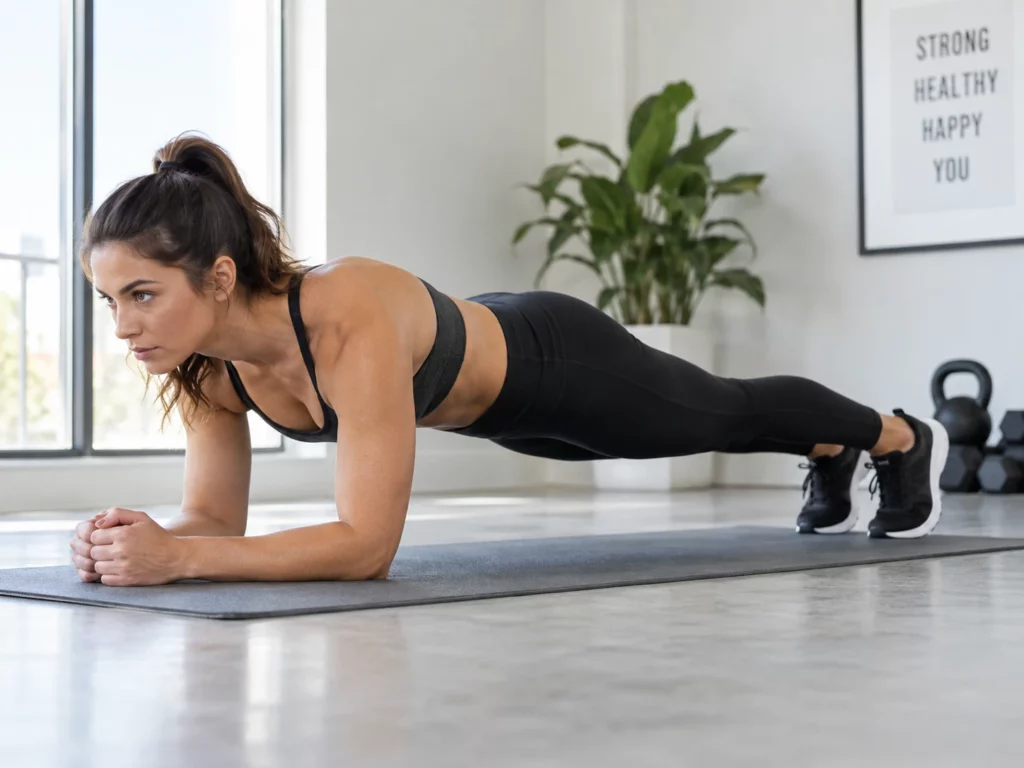
Although the plank does not require much movement, your muscles keep on working.
Your abdominal muscles work hard to avoid a large arching of the lumbar spine, while the muscles of the buttocks, shoulders, and other stabilizing muscles help you with body alignment.
Make sure that your head, shoulders, hips, and ankles are aligned in one line.
It is advised to start with:
2-3 sets of 15-30 seconds
As soon as you get used to holding proper alignment for 30 seconds, slowly add time to reach 30-60 seconds.
Once you have reached 60 seconds of plank, there is no use in staying in the same position for more minutes, so it is time to change it to something more difficult.
2. Crunches vs. Planks: Which Is Better for Losing Belly Fat?
People exercise through movements like doing crunches and planks because they wish to have flat abs. But the difference between building up one’s abdominal muscles and trimming down the belly fat is that:
Can Crunches Burn Belly Fat?
Though crunches can help build up your abdominal muscles, crunches cannot assist your body in eliminating the fat in your abdominal area.
The reason is that the reduction in fat in your body is largely dependent upon the overall energy balance in your body. If your body uses more energy than you consume, then the fats will be burned by your body.
For instance, if your body weight is maintained at a constant level of 2,300 calories, even if your body consumes 2,000 calories, there will be a deficit of 300 calories.
These numbers are just for illustrative purposes only, as the actual need for energy depends upon many other factors like age and body weight.
If a person does 100 crunches per day, this won’t compensate for the deficit of calories.
Do Planks Burn More Calories?
Planks are also not meant to be exercises that burn many calories. The primary reason for doing planks is to build core strength and stability.
If reducing body fat is the goal, a broader approach is more effective:
• Maintain an appropriate calorie intake
• Perform regular strength training
• Include aerobic exercise
• Increase daily physical activity
• Get adequate sleep and recovery
Crunches and planks can support a fitness program, but neither should be treated as a complete fat-loss strategy.
Visible Abs Depend on More Than Exercise
The visibility of the abdominal muscles depends on certain factors like body fat percentage, tone of abdominal muscles, distribution of body fat, and genetics.
Therefore, two people doing exactly the same exercises to get fit abs will produce very different results depending on their bodies.
Instead of wondering how many crunches you need for abs, the more important question to ask would be about the sustainability of the program.
3. Crunches vs. Planks: Which Should You Choose?
The better exercise depends on what you want to improve.
| Training Goal | Better Choice |
| Direct abdominal training | Crunches |
| Trunk stability | Planks |
| Dynamic core training | Crunches |
| Anti-extension training | Planks |
| Beginner core workout | Both |
| Well-rounded core program | Both plus other movements |
Choose Crunches for Direct Abdominal Training
Crunches are helpful when you need to exercise your abs within a range of motion.
Make sure not to pull your neck while lifting your body using momentum. It would be more effective to do 10–15 controlled reps rather than many repetitions with poor technique.
Choose Planks for Stability
Planks will be more appropriate for developing skills in keeping the body stable.
These skills can be applied while running, cycling, weightlifting, and during any other exercise involving the movement of your body.
You should stop the set once you feel that your back starts to sag or your hips start rising too high. A properly performed 30-second plank is worth much more than a poorly performed two-minute plank.
Build a More Complete Core Routine
Core function extends beyond crunching and holding a plank. A balanced routine can include:
• Crunches for dynamic flexion
• Front planks for anti-extension
• Side planks for lateral stability
• Bird dogs for trunk control
Beginners can train the core 2–3 times per week, using three or four exercises per session and gradually increasing difficulty as strength improves.
4.Conclusion
Plank exercise and crunches build strength in the core, but for different reasons. While plank exercise mainly focuses on core stability, crunches primarily involve the contraction of the abdominal muscles.
For an average person, it would be best to perform both of these exercises as opposed to selecting one of them only. However, it is impossible for either of these two exercises to eliminate belly fat alone.
Instead, it would be better to perform several good crunches and plank for 30 to 60 seconds.