
目录
It may be quite difficult for someone to start an exercise program if they do not know what types of exercises to do, how often, and how intensely to train. The ideal workout routine for a beginner must build muscle strength, enhance cardiovascular endurance, teach skills, and allow adequate time for recovery between workout days. Beginners need not concentrate on achieving intensity but rather consistency in their training.
Everyone needs a different workout routine depending on his/her training background, age, training equipment, physical status, schedule, and training goals. Most beginners will find it wise to combine both full-body strength training workouts and moderate cardiovascular workouts.

What Should a Beginner Workout Routine Include?
A complete beginner workout routine is supposed to include different aspects of physical fitness rather than one aspect only. Strength training is used to enhance muscle strength, cardio enhances heart and lung function, while warming up prepares the body for any movement.
Warm-Up and Cool-Down
The warm-up is the process where the body gets ready for the exercises through a gradual increase in movement. The warm-up might prove helpful before strength training and cardio, as it gives the body enough time for the transition without being forced into immediate intense activities. One can use the following warm-up routine, which usually takes about 5-10 minutes:
- Easy walking or cycling for several minutes.
- Controlled joint movements.
- Dynamic movements related to the upcoming workout.
- A few low-intensity repetitions of the main exercises.
To make the transition after training, one needs to spend several minutes doing light exercises, and, if necessary, some stretches might be done at this point as well.
Strength Training for Major Muscle Groups
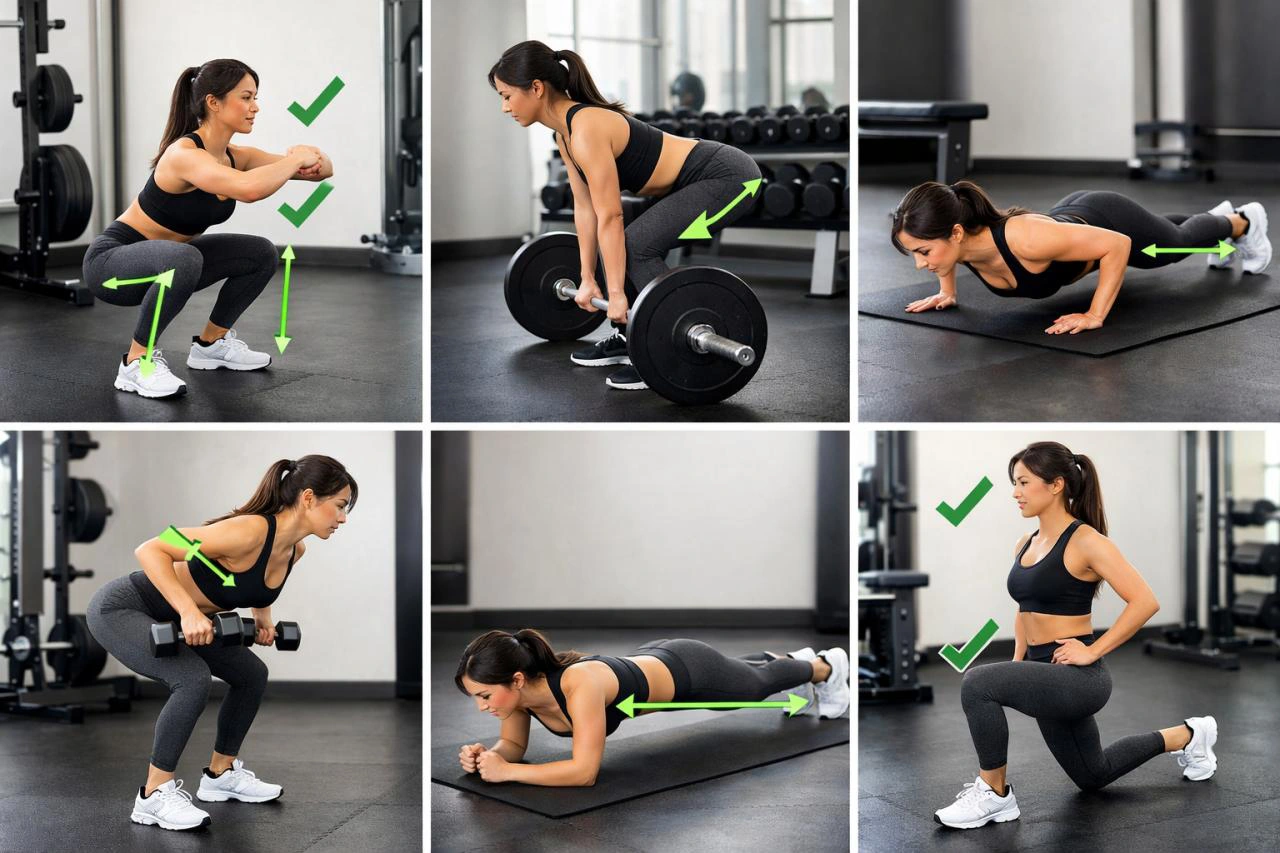
Strength training should definitely be a key component of the beginner’s regimen, as it helps develop control over basic movements. No heavy weights or fancy equipment is needed here for beginners; it would be enough to use bodyweight training, resistance bands, dumbbells, or machines, depending on the individual situation. Such exercises as squats, lunges, step-ups, deadlifts, push-ups, etc. can be used for working out the whole body:
- Squat or leg press: legs and hips
- Push-up or chest press: chest, shoulders, and triceps
- Row: upper back and arms
- Glute bridge: glutes and posterior chain
- Plank: core stability
For many beginners, 1–3 sets of 8–12 repetitions per exercise is a reasonable starting range. The resistance should allow controlled movement without sacrificing technique. Rest periods of approximately 60–120 seconds between sets can provide enough recovery for general strength work. Technique should come before increasing resistance. The person who can do 10 controlled repetitions of the exercise with good posture would have a better foundation for further progress.
Cardio for Endurance and Fitness
Cardio exercise helps strengthen the heart muscle and improve one’s ability to exercise by raising aerobic endurance. Beginners can engage in various activities according to individual preference and joint health condition: fast walking, cycling, swimming, rowing, or even jogging. The recommended amount of cardio exercise for beginners would be 20-30 minutes per session; however, for people who have not exercised for quite a long time, the recommended amount of cardio exercise is 10-15 minutes of exercise per session.
Moderate-intensity exercise means that it is possible to breathe faster but still talk. One does not necessarily need to engage in cardio exercise every day since combining two to three sessions of moderate cardio exercise with strength exercises will be a reasonable amount of work and recovery time for the person. The combination of different types of cardio exercise can make the training more interesting and help people continue exercising.
How Often Should Beginners Work Out?
Frequency of training should be high enough to ensure practice but not so high to ensure recovery. If one is a beginner in doing exercises regularly, more sessions of exercising will not always be better.
Start With 3 Days a Week
Three times a week is a realistic approach for many beginners. With such a frequency of workouts, it is possible not only to have rest days between sessions but also to provide regular training that will help to achieve a certain basic level of fitness. A sample schedule would be:
| Day | Training | Approximate Duration |
| Monday | Full-body strength | 30–45 minutes |
| Tuesday | Rest or easy walking | 15–30 minutes |
| Wednesday | Moderate cardio | 20–30 minutes |
| Thursday | Rest | — |
| Friday | Full-body strength | 30–45 minutes |
| Saturday | Optional light activity | 20–40 minutes |
| Sunday | Rest | — |
An alternative approach can include working out three days a week – performing a full-body strength workout on Monday, Wednesday, and Friday, while walking or performing any other kind of light activity on other days of the week. Depending on the life situation and other things, this schedule can be customized. The important thing is to create a schedule that can be followed regularly. For beginners, the main tasks are to learn basic exercises and build proper exercise habits.
Balance Training and Recovery
Recovery plays an important role in any training program. Working out itself gives a stimulus to the body, but adaptations take place when the body recovers from the stimulus. Without sufficient recovery, the next workouts may be too hard for the person. Beginners should pay attention to several recovery factors:
- Sleep: Aim for approximately 7–9 hours per night for most adults.
- Rest days: Include at least one or more lower-load days each week.
- Hydration: Drink fluids regularly and increase intake when exercise or environmental conditions increase fluid loss.
- Nutrition: Consume sufficient energy and a balanced diet containing protein, carbohydrates, fats, vitamins, and minerals.
- Training load: Increase exercise gradually instead of making large jumps from one week to the next.
Muscular soreness is quite common when trying out something new; however, extreme pain does not fall into that category. Another factor to take into account when just starting is gradual progression by increasing resistance, repetitions, cardio, or proper movement coordination once the exercises have become easy. The beginner workout program should be focused on regularity rather than the complexity of a regimen.
Conclusion
There is no need for a workout program for beginners to be too complex or challenging. Such elements as full-body strength exercises, cardio, proper warm-ups, and recovery will provide a solid basis for future development. For instance, it might be wise to start with about three training sessions a week, which will provide enough practice and recovery time.
With increasing fitness, it is possible to gradually increase the amount of time spent on training, resistance, repetitions, or intensity. Tracking one’s workout results will also help to assess performance and make necessary adjustments. Most importantly, the beginner workout routine should consist of activities one can manage to do.
0