目录
A liquid packaging line is a highly coordinated mechanical system. Its core value lies in transforming fluid liquids into standardized products with uniform specifications and a secure seal. As key equipment for ensuring the safe and efficient packaging of liquid products, it serves as a vital bridge connecting liquid raw materials with end-consumer consumption.
1. Liquid Packaging Line
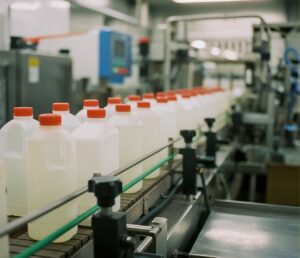
The operational processes of a liquid packaging line are interconnected, forming a complete transformation chain.
- Taking dairy product filling as an example, the first step is quantitative filling: the container is precisely transported by a conveyor belt to the bottom of the canning head.
- The canning head stops accurately according to a preset program and adjusts the flow rate and filling speed to pour the measured amount of milk into the bottle.
- During this process, sensors monitor liquid level changes in real time, and servo valves dynamically adjust the flow rate to ensure that the capacity of each bottle is accurate to the millimeter.
- After filling is completed, the bottle enters the sealing stage. An automatic capping device accurately covers the bottle mouth with an aluminum foil cap.
Then, a heat sealing device presses down. Through precise control of temperature and pressure, the aluminum foil fuses with the sealing surface of the bottle mouth, forming a tight barrier.
This step is crucial for ensuring product safety, completely isolating the contents from outside air and microorganisms, and directly determines the product’s shelf life.
After sealing, the bottles travel via a conveyor belt to the packaging stage. A robotic arm, using a vision positioning system, grabs the bottles and neatly stacks them into cartons according to a pre-set arrangement.
Next, the finished goods from the carton sealer are transported to the palletizing area. A palletizer stacks the cartons according to the required height and quantity. After securing them with stretch film, they are transported by forklift to the warehouse, awaiting shipment.
2. Precision Control
- Precision control is the lifeblood of the liquid packaging line and is implemented throughout the entire production process.
- In the metering process, the equipment is equipped with a high-precision electromagnetic flowmeter and a servo proportional valve, which strictly controls liquid volume error within ±0.5ml.
- Even small-volume packages of 50ml can maintain stable accuracy.
The visual inspection system acts as a “digital eye,” monitoring every node of the production line in real time: whether the bottle is cracked, whether the liquid level is meeting the standard, and whether the seal is smooth and wrinkle-free, ensuring 100% compliance with the product quality standards.
To meet the hygiene requirements of industries such as food and daily necessities, the aseptic filling area adopts a fully enclosed design. High-efficiency air filters maintain Class 100 cleanliness levels. UV disinfection and hydrogen peroxide atomization sterilization systems are also installed to eliminate the risk of microbial contamination.
While ensuring accuracy and hygiene, the production line can still operate stably at a rate of 300 bottles per minute, equivalent to filling and initial processing five bottles of product per second, achieving a balance between high precision and high efficiency.
3. Key to Flexible Production and Efficiency Improvement
An intelligent management system injects flexibility into the packaging line.
- The modular design enables rapid changeovers: when switching bottle types or adjusting capacity, simply replace the corresponding filling head, conveyor track, and robotic gripper, and coordinate parameter adjustments via the central control system.
- This significantly reduces production changeover time and adapts to modern production demands.
The central control system connects all equipment across the entire line via the Industrial Internet, collecting real-time operating data and automatically optimizing operating parameters based on algorithms.
The predictive maintenance system analyzes historical data such as equipment vibration, temperature, and energy consumption to establish a fault warning model, providing 1-3 days of advance warning of potential failures. This shifts maintenance from “post-event repair” to “pre-emptive” prevention, reducing unplanned downtime by over 30%.
- These intelligent management measures have collectively increased Overall Equipment Effectiveness (OEE) to over 85%, reduced energy consumption and labor costs per unit product by 15-20%, and created significant economic benefits for the company.
The liquid packaging line takes “flow order” as its core logic, transforms disordered liquids into ordered commodities through precise control, and achieves dual improvements in efficiency and flexibility with the help of intelligent management, becoming an indispensable core link in the industrial production of modern liquid products.
0