目录
The 48V 100Ah lithium ion battery is one of the best batteries to use for home energy storage, power backup, and certain applications of off-grid energy systems. This battery will hold around 4.8–5.12 kWh, depending on its nominal voltage. Each battery model has a unique battery management system (BMS), protection level, interface, and expandability.
To provide you with a good overview and help you choose between the existing options, we have prepared ten examples of batteries from nine manufacturers, such as Felicity Solar, EG4, Deye, Pylontech, Dyness, Pytes, RELiON, Voltsmile, and BSLBATT. Please always double-check specifications with the manufacturer’s data sheet.
Why Choose a 48V 100Ah Lithium Ion Battery?
Reliable Power for Daily Energy Needs
A 48V 100Ah lithium ion battery is a fair balance between the capacity and size of the system. For example, a 5.12 kWh battery can theoretically supply energy to a 500 W load in 10.2 hours, ignoring conversion loss and available capacity. For anyone purchasing a 48V 100Ah lithium ion battery, usable energy is just as important to evaluate as nominal capacity.
Longer Runtime for Solar and Off-Grid Applications
Lithium iron phosphate (LiFePO₄) batteries are often used for solar energy storage because of the longevity and built-in battery protection features. Several compatible battery modules may also be connected to improve capacity. In this regard, the 48V 100Ah Lithium Ion Battery can be used as a modular storage device provided that the battery, inverter, and parallel capability are available.
Lower Maintenance Requirements
Compared with the conventional lead-acid batteries, lithium-ion batteries require less maintenance. But when consumers are purchasing a 48V 100Ah Lithium Ion Battery, they have to think about the temperature conditions, charging conditions, warranty, and inverter compatibility.
What are the Top 10 Recommended 48V 100Ah Lithium Ion Battery Options?
Quick Overview of 10 Recommended 48V 100Ah Lithium Ion Batteries
| Product | Nominal Voltage | Capacity | Key Features | Recommendation Score |
| Felicity Solar LPBA48100-OL | 51.2V | 5.12kWh | IP65, aerosol fire suppression | ★★★★★ |
| EG4 LL-S | 51.2V | 5.12kWh | LCD touchscreen, modular expansion | ★★★★★ |
| Deye SE-F5-A | 51.2V | 5.12kWh | Bluetooth monitoring, 100A continuous discharge current | ★★★★☆ |
| Felicity Solar
FLS48100SG2 |
51.2V | 5.12kWh | Wi-Fi monitoring, LCD display | ★★★★★ |
| Pylontech US5000 | 48V | 4.8kWh | 4.56kWh usable energy, rack design | ★★★★★ |
| Dyness B48100 | 48V | 4.8kWh | Defined continuous and peak current limits | ★★★★☆ |
| Pytes V5 | 51.2V | 5.12kWh | Modular design, up to 100A continuous current | ★★★★☆ |
| RELiON RB48V100 | 51.2V | 5.12kWh | IP65, high discharge capability | ★★★★☆ |
| Voltsmile V10 | 51.2V | 5.12kWh | Rack-mounted, parallel expansion | ★★★★☆ |
| BSLBATT Powerline-5 | 48V | 5.12kWh* | Wall-mounted, slim profile | ★★★★☆ |
1. Felicity Solar LPBA48100-OL
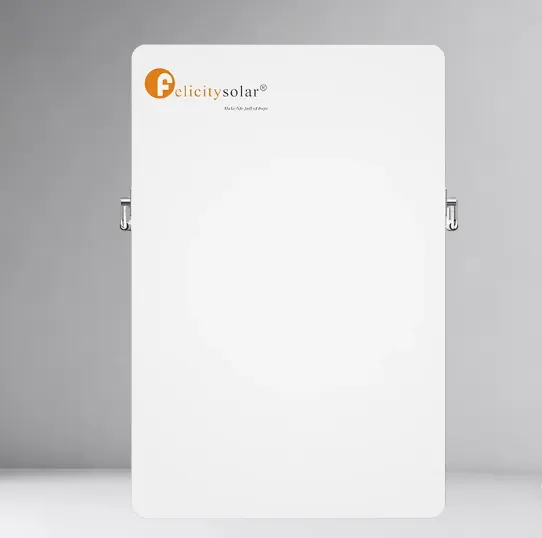
The Felicity Solar LPBA48100-OL is a 51.2V, 100Ah LiFePO₄ battery with 5.12kWh of nominal energy. Designed for residential energy storage, it features an IP65-rated enclosure, flexible wall or floor installation, and integrated aerosol fire suppression. This 48V 100Ah Lithium Ion Battery also includes a smart BMS, RS485/CAN communication, at least 95% rated depth of discharge, and a cycle life of at least 6,000 cycles. Up to 12 units can be connected in parallel for expanded storage capacity.
2. EG4 LL-S 48V 100Ah Lithium Iron Phosphate Battery
The EG4 LL-S 48V 100Ah battery is a rack-mounted energy storage solution with a nominal voltage of 51.2V and 5.12kWh capacity. Its features include an onboard LCD touchscreen, BMS monitoring, emergency-stop functionality when configured with compatible equipment, and dual onboard fire arrestors.
The EG4 has a minimum design life of more than 15 years and allows a maximum of 64 batteries in parallel. This 48V 100Ah Lithium Ion Battery might be right for customers whose storage requirements are expected to increase with their rising demands or generation of solar power.
3. Deye SE-F5-A 51.2V 100Ah Lithium Battery
The Deye SE-F5-A provides 5.12kWh nominal energy storage and has LiFePO₄ chemistry. It supports up to 100A of continuous charge and discharge rates. The monitoring options of Deye SE-F5-A include CAN 2.0, RS485, and a Bluetooth app. The specified cycle-life rating by the company is at least 6,000 cycles. Its compact design and monitoring functions make it a potential choice for residential energy storage, provided the battery is compatible with the selected inverter and installation requirements.
4. Felicity Solar FLS48100SG2
The Felicity Solar FLS48100SG2 has a voltage of 51.2V and 100Ah of battery capacity. Its nominal energy is 5.12kWh per battery. It has a built-in Wi-Fi monitor, LCD and LED display screen, smart BMS, and RS485/CAN. Felicity Solar FLS48100SG2 allows a maximum of eight batteries to connect in parallel, giving an aggregate storage capacity of 40.96kWh. Its specified cycle life is a minimum of 6,000 cycles. This battery is worth evaluating for residential solar storage and backup systems that require monitoring and modular expansion.
5. Pylontech US5000 48V Lithium Battery
The Pylontech US5000 battery is a 48V lithium iron phosphate battery that has a nominal energy of 4.8kWh and usable energy of 4.56kWh. Being 19-inch rack-mountable, it is suitable for modular stationary storage systems. The manufacturer provides information about the depth of discharge of 95%, normal charge/discharge current of 100A, and 16 modules per string. When comparing it to other 48V 100Ah Lithium Ion Batteries, its usable energy will help users understand the amount of energy that can be used regularly.
6. Dyness B48100 48V 100Ah Battery
The Dyness B48100 is a 48V, 100Ah battery module with 4.8kWh of nominal energy. Its published specifications list a recommended charge/discharge current of 50A, a maximum current of 75A, and a peak current of 100A for 15 seconds. For applications requiring stationary energy storage or backup power, this model may be suitable if the system specifications match. Its current limits should be matched to inverter demand, particularly when loads have high startup currents.
7. Pytes V5 51.2V 100Ah LFP Battery
Pytes V5 is a 51.2V, 100Ah LiFePO₄ battery with a nominal energy of 5.12kWh. The manufacturer of this battery provides a recommended charge/discharge current of 75A and a maximum continuous current of 100A. Its modular design supports expansion for larger residential and distributed energy storage projects. The manufacturer claims that the cycle life of this battery is over 6,000 cycles. Consumers need to check compatibility with the inverter, operating temperature, and the expansion configuration before purchase.
8. RELiON RB48V100 Lithium Battery
The RELiON RB48V100 battery offers 51.2V nominal voltage, 100Ah capacity, and 5,120Wh energy. Specifications include IP65 enclosures, a maximum continuous discharge current of 200 A, a peak discharge current of 250 A for four seconds, 99% efficiency, and 80% capacity retention after 3,500 cycles. For applications requiring a high-output 48V 100Ah Lithium Ion Battery, continuous and peak discharge ratings deserve particular attention, along with the manufacturer’s connection restrictions.
9. Voltsmile V10 Rack-Mounted 51.2V 100Ah Battery
Voltsmile V10: This rack-mounted battery has a LiFePO4 chemical composition, with a voltage of 51.2V, 100Ah, and a capacity of 5.12kWh. It allows both charging and discharging at 100A, has CAN/RS485 communication, and can be expanded into up to 63 batteries in parallel, based on its technical specifications.
Its IP20 rating means that it will need a suitable installation environment. Based on its rack mounting and expansion features, it is worth considering for energy storage applications in residential areas and in larger battery bank systems.
10. BSLBATT Powerline-5 48V 100Ah Wall-Mounted Battery
The BSLBATT Powerline-5 is a wall-mounted LiFePO₄ battery rated at 48V and 100Ah, with 5.12kWh of capacity. Its slim 90mm profile is designed to help reduce installation space requirements. BSLBATT specifies a cycle life exceeding 6,000 cycles at 90% depth of discharge and supports up to 32 units in parallel. Its intelligent BMS and compatibility with many types of 48V inverters make it suitable for energy storage in homes and light businesses, depending on confirmation of the exact inverter type that it is compatible with.
Conclusion
The 10 proposed 48V 100Ah Lithium Ion batteries offer different choices for energy storage needs, including residential solar energy systems, off-grid solutions, and backup power systems, among others. Their differences include installation design, monitoring capabilities, discharging capabilities, and system expansion, among others. In choosing a 48V 100Ah Lithium Ion Battery, it is important to consider usable capacity, continuous discharge currents, BMS protection, inverter compatibility, and system scalability.
0